


India Chemical Industry 2040: How a $220 Billion Market Plans to Hit $1 Trillion
APAC Supply Chain | Market Intelligence · Series: Industrial Chemicals & Supply Chain Intelligence · July 2026
India Chemical Industry 2040: How a $220 Billion Market Plans to Hit $1 Trillion
In 2023, global oversupply and weak demand were squeezing margins across Indian chemical manufacturing. Three years later, the conversation has shifted entirely: can the industry actually quadruple by 2040? The latest data — export numbers, capex announcements, and government policy — suggests the answer is being built right now, project by project. Here's what the numbers show, and what it means for procurement and sourcing teams evaluating India as a supply base.
Table of Contents
- India's Chemical Market: Size Today & Growth Trajectory
- FY26 Export Performance & Global Standing
- The Capex Pipeline: Refineries, PCPIRs & Policy Support
- Commodity vs. Specialty: Where the Real Opportunity Sits
- What This Means for Global Sourcing Teams
- How APAC Supply Chain Supports India-Based Sourcing
- Frequently Asked Questions
- Conclusion
1. India's Chemical Market: Size Today & Growth Trajectory
India's chemical industry is currently valued at $220–250 billion, positioning it as the world's 6th-largest chemical producer and the 3rd-largest in Asia. The sector now contributes approximately 7% of India's GDP — a scale that puts it firmly among the country's core industrial pillars, alongside IT and manufacturing.
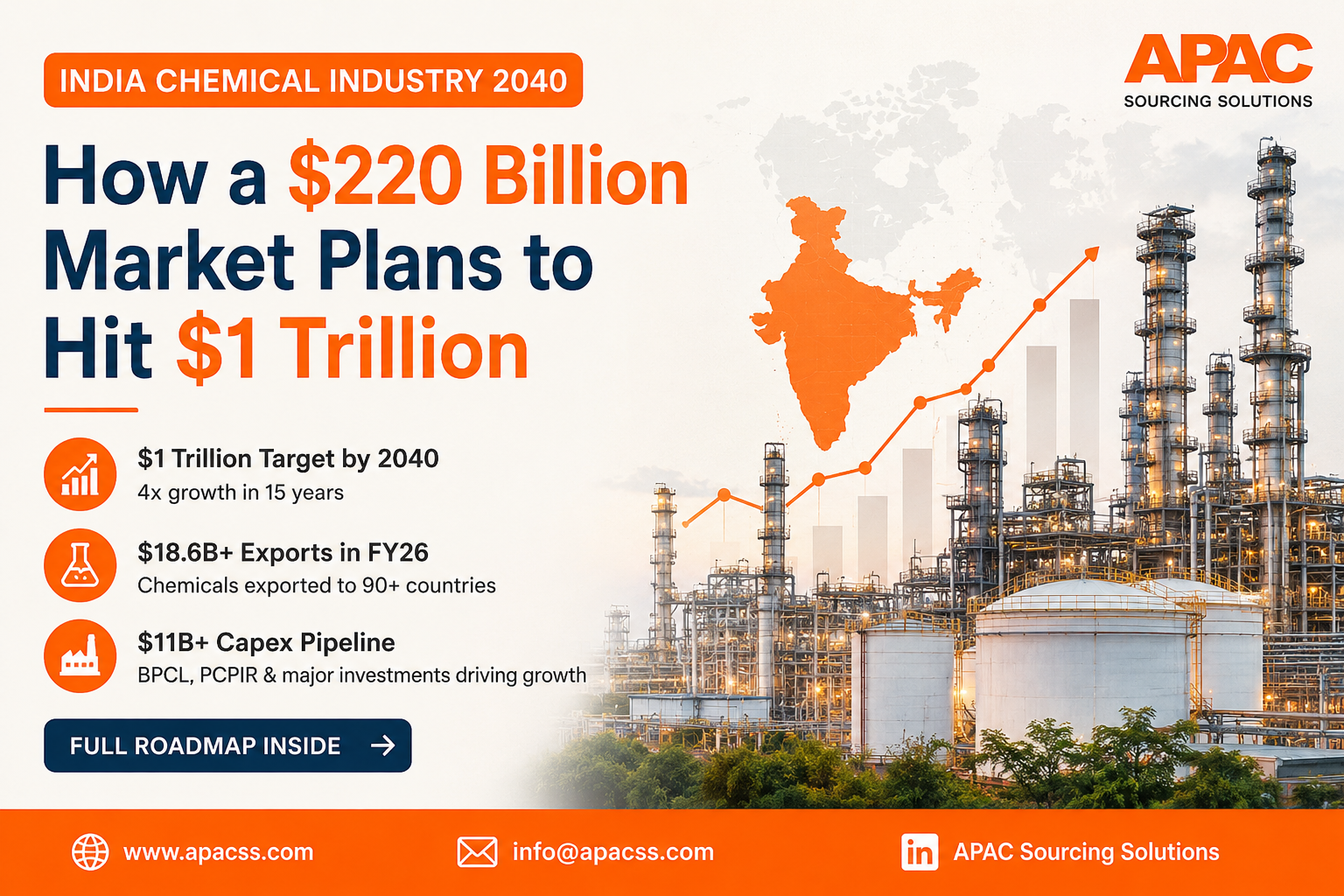
The forward projections are the real story. Industry estimates put the market at approximately $300 billion by 2030, climbing toward nearly $1 trillion by 2040 — roughly a 4x expansion in 15 years. That kind of growth curve doesn't happen on demand alone; it requires sustained capacity build-out, policy backing, and a widening base of export relationships, all of which are visibly underway.
2. FY26 Export Performance & Global Standing
India's chemical exports crossed $18.6 billion in FY26. Perhaps more telling than the headline figure is the specificity of India's global position: the country holds 16–18% of global dye and dye-intermediate production, exported to more than 90 countries. That is a durable, technically defensible market share — not a temporary trade shift.
Specialty chemicals — APAC's core sourcing category — have crossed $60 billion in value and are growing faster than the broader chemical industry. This is the segment where India is building genuine differentiation rather than competing purely on cost.
3. The Capex Pipeline: Refineries, PCPIRs & Policy Support
What separates this growth story from prior cycles of optimism is the scale of capital actually being deployed:
| Project / Policy | Investment | Location / Scope |
|---|---|---|
| BPCL + Oil India refinery-petrochemical complex | ~$11 billion | Andhra Pradesh, incl. new ethylene cracker |
| Dahej PCPIR | ~₹1 lakh crore | Gujarat |
| Paradip PCPIR | ₹73,500+ crore | Odisha |
| National PCPIR-led investment target | ₹20 lakh crore | By 2035, across India |
| Union Budget 2026–27: Chemical Parks | ₹600 crore | 3 new Chemical Parks |
| Union Budget 2026–27: CCUS deployment | ₹20,000 crore | Over 5 years |
| FDI via automatic route | ~$24 billion | Cumulative since 2000 |
Taken together, these are not isolated announcements — they represent a coordinated build-out across feedstock (refinery-petrochemical integration), regional clusters (PCPIRs), and downstream capability (Chemical Parks, CCUS), backed by consistent policy support through 100% automatic-route FDI.
4. Commodity vs. Specialty: Where the Real Opportunity Sits
Commodity Segment Reality
Phenol, acetone, and basic petrochemicals are still working through global overcapacity and margin pressure. This part of the industry is not where near-term differentiation lies.
Where the Value Is
Specialty chemicals, fluorochemicals, electronic chemicals, and technologically differentiated products, segments where India is building a distinct position rather than competing on price alone.
5. What This Means for Global Sourcing Teams
The practical takeaway for procurement and sourcing professionals: global buyers are actively expanding where they source from, adding India alongside existing supply relationships rather than replacing them. This is a widening map, not a swap.
For buyers evaluating supply diversification, the specialty chemical segment offers the clearest entry point: it is growing faster than the broader industry, benefiting from targeted capex, and less exposed to the overcapacity pressure weighing on commodity petrochemicals.
6. How APAC Supply Chain Supports India-Based Sourcing
Verified Manufacturer Network
Direct access to quality-certified Indian chemical manufacturers across specialty, fine, and industrial chemical categories.
Documentation & Compliance
CoA, Certificate of Origin, SDS/TDS, and regulatory documentation managed end-to-end for international buyers.
LCR–HCR Bridge
We connect Low Cost Region manufacturers directly to High Cost Region buyers — bridging supply and demand across both worlds.
Exploring India as a Sourcing Destination?
Tell us your product category and volume requirements — we'll come back with verified Indian manufacturer options.
✉ Email Our Team Explore apacss.com →7. Frequently Asked Questions
How big is India's chemical industry today?
India's chemical industry is currently valued between $220 billion and $250 billion, making it the world's 6th-largest chemical producer and 3rd-largest in Asia, contributing approximately 7% of GDP.
What is India's chemical industry growth target for 2040?
Projections put the market at approximately $300 billion by 2030 and near $1 trillion by 2040, roughly a 4x expansion over 15 years.
How much did India export in chemicals in FY26?
India's chemical exports crossed $18.6 billion in FY26, with the country holding 16–18% of global dye and dye-intermediate production, exported to 90+ countries.
What major investments are driving this growth?
Key projects include an ~$11 billion BPCL/Oil India refinery-petrochemical complex in Andhra Pradesh, ~₹1 lakh crore in the Dahej PCPIR, ₹73,500+ crore in the Paradip PCPIR, and a government target of ₹20 lakh crore in PCPIR-led investment by 2035.
Which chemical segments offer the most sourcing opportunity?
Specialty chemicals, fluorochemicals, and electronic chemicals — segments that have crossed $60 billion and are growing faster than the broader industry — offer the strongest opportunity, while commodity segments like phenol and acetone remain pressured by global overcapacity.
8. Conclusion
India's path from a $220–250 billion chemical industry to a projected $1 trillion market by 2040 is backed by tangible capex, consistent policy support, and a growing specialty chemicals base — not projections alone. For global sourcing teams, the opportunity is not to replace existing supply relationships but to add India into the mix while the window for building those relationships is still open.
If you're evaluating India as part of your sourcing strategy, we welcome the conversation — reach out to our team at info@apacss.com or explore our full sourcing portfolio at www.apacss.com.


