


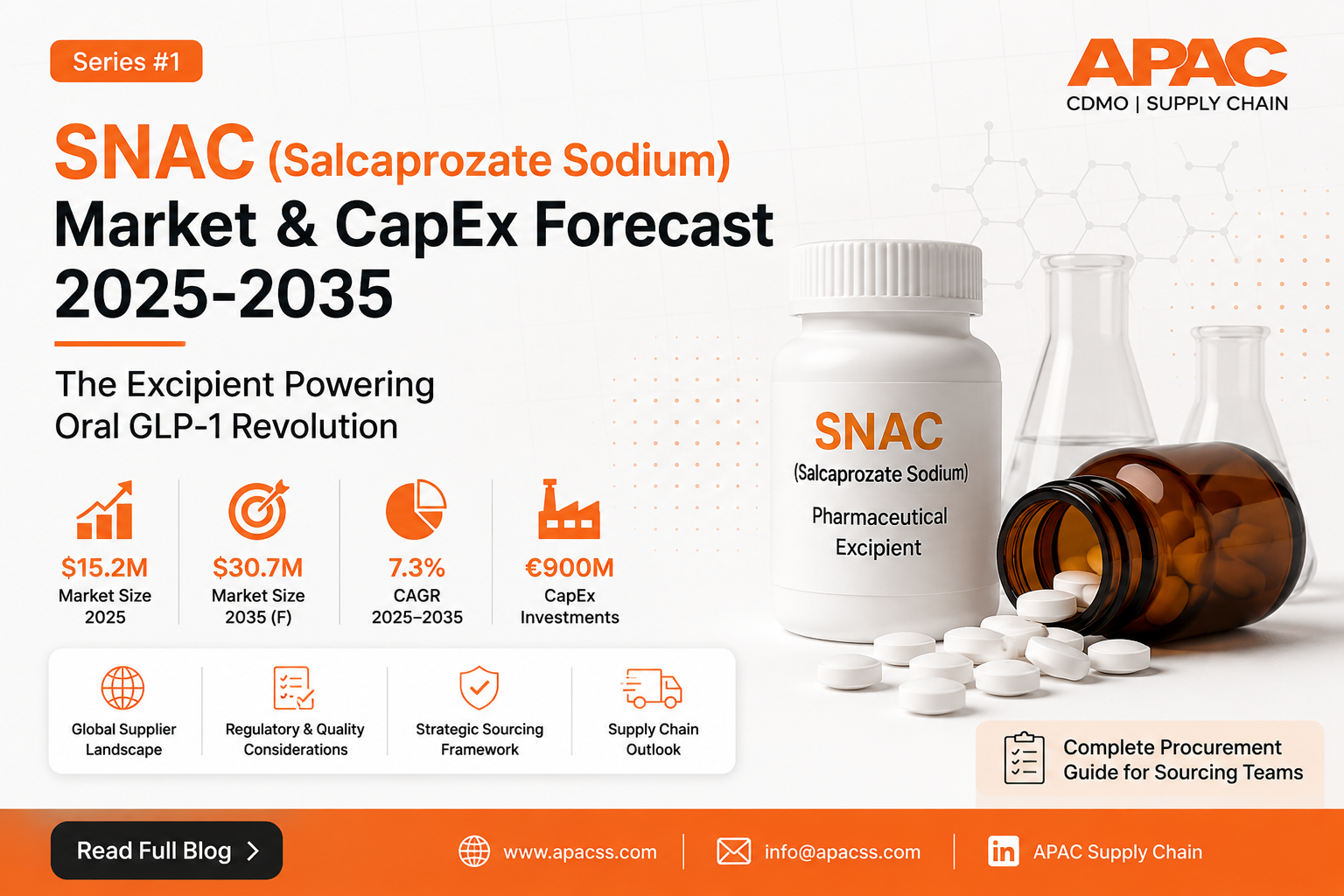
SNAC (Salcaprozate Sodium): Global Market Forecast, CapEx Outlook & Procurement Strategy 2025-2035
In brief: SNAC -- Sodium N-[8-(2-Hydroxybenzoyl)Amino] Caprylate -- is the pharmaceutical excipient that makes oral GLP-1 drugs possible. It is the core ingredient in Rybelsus® and the FDA-approved Wegovy® pill, which launched in the US in January 2026. The global SNAC excipient market is projected to grow from $15.2M (2025) to $30.7M by 2035 at a 7.3% CAGR, with over €900M in manufacturing CapEx already committed. This guide covers the full market picture, supplier landscape, and what procurement teams need to do now.
1. What Is SNAC? Chemistry, Function & Role in Oral Drug Delivery
SNAC -- Sodium N-[8-(2-Hydroxybenzoyl)Amino] Caprylate -- is a synthetic pharmaceutical excipient classified as an intestinal permeation enhancer. Its chemical name is sodium 8-[(2-hydroxybenzoyl)amino]octanoate, with CAS number 203787-91-1 and molecular formula C15H2₀NNaO4. It is also known by its USAN name Salcaprozate Sodium.
SNAC was developed specifically to solve one of pharmaceutical science's most persistent problems: the oral bioavailability of peptide drugs. Peptides like semaglutide are large molecules that are enzymatically degraded in the gastrointestinal tract and poorly absorbed across the intestinal membrane. Without an absorption enhancer, they must be delivered by injection.
How SNAC Works: The Mechanism
When co-administered with a peptide drug in a tablet formulation, SNAC creates a localised, temporary microenvironment of elevated pH around the drug molecule in the gastric mucosa. This pH buffering effect serves two functions simultaneously:
Key context: SNAC is not a new molecule. It was studied by Emisphere Technologies in the 1990s and licensed to Novo Nordisk, which spent over a decade optimising the semaglutide-SNAC formulation that became Rybelsus® (approved by the FDA in 2019). The Wegovy® pill approval in December 2025 marks SNAC's entry into the mass-market obesity treatment space -- a step-change in demand potential.
2. Why SNAC Demand Is Surging in 2025-2026: The GLP-1 Catalyst
The trajectory of SNAC demand is inseparably linked to the global GLP-1 receptor agonist market -- one of the fastest-growing pharmaceutical categories in history. Global GLP-1 sales were estimated at $65.8 billion in 2025 and are forecast to reach $324.5 billion by 2035, growing at a CAGR of 17.3% (FactMR, 2025).
Within this market, the shift from injectable to oral GLP-1 formulations is the defining trend of 2025-2026, and SNAC is the excipient that makes it possible.
The December 2025 Inflection Point
⚡ December 22, 2025: The US FDA approved Wegovy® pill (oral semaglutide 25 mg once-daily) -- the world's first oral GLP-1 receptor agonist approved for obesity and weight management.
🚀 January 2026: US market launch commenced. Manufacturing based in North Carolina.
🌍 EU/Global: Novo Nordisk submitted oral semaglutide for EMA approval and other regulatory authorities in H2 2025. Approval pending.
💊 Clinical result: OASIS 4 trial showed 16.6% mean weight loss at 64 weeks with full adherence -- comparable to injectable Wegovy® 2.4 mg. One in three patients achieved ≥20% weight loss.
The Wegovy® pill's FDA approval is the single most significant demand catalyst for SNAC since Rybelsus® launched in 2019. Obesity treatment represents a vastly larger patient population than type 2 diabetes alone -- Novo Nordisk has stated confidence in its ability to supply the market, and the demand trajectory for oral semaglutide is expected to significantly exceed all pre-2026 SNAC market forecasts.
Additionally, Novo Nordisk has agreed with the US Administration to lower semaglutide prices across Medicare and Medicaid from 2026, with a three-year tariff exemption -- a policy development that will meaningfully expand the US patient population accessing oral semaglutide and, by extension, SNAC demand.
3. Global Market Size & Forecast 2025-2035
Market sizing for SNAC varies across research providers depending on scope -- whether measuring the pure pharmaceutical excipient, the broader salcaprozate sodium ingredient market, or the end-market GLP-1 supply chain. The table below provides a consolidated view of key forecasts:
| Research Provider | Market Scope | Base Value | Forecast Value | CAGR | Period |
|---|---|---|---|---|---|
| Future Market Insights | Pharma excipient SNAC | $15.2M (2025) | $30.7M | 7.3% | 2025-2035 |
| Intel Market Research | SNAC for semaglutide | $13M (2024) | $21.8M | 7.9% | 2024-2032 |
| Valuates Reports | Salcaprozate sodium ingredient | $3,634M (2024) | $7,816M | 12.7% | 2024-2031 |
| Market Research Intellect | SNAC market (broad) | $16.33Bn (2024) | $26.8Bn | 7.33% | 2024-2031 |
| Virtue Market Research | GLP-1 supply chain & fill-finish | $8.42Bn (2025) | $21.89Bn | 21.1% | 2025-2030 |
| Fortune Business Insights | Peptide synthesis market | $800M (2026) | $1.64Bn | 9.39% | 2026-2034 |
How to read this data: The wide variation in figures reflects different market scope definitions. For procurement and sourcing purposes, the most directly relevant figures are the Future Market Insights pharmaceutical excipient SNAC market ($15.2M → $30.7M, 7.3% CAGR) and the Intel Market Research semaglutide-specific figure ($13M → $21.8M). The larger figures reflect the entire GLP-1 manufacturing ecosystem, not SNAC alone. All forecasts were published pre-Wegovy® pill approval -- actual demand is likely to outperform these projections.
4. Global CapEx Wave: Who Is Investing and How Much
The SNAC and GLP-1 manufacturing expansion story is one of the most significant pharmaceutical CapEx cycles in recent history. Billions of dollars are flowing into peptide manufacturing infrastructure globally -- investments that will determine the future supply, pricing, and geographic distribution of SNAC production capacity.
| Company | Investment | Focus | Timeline | Locations |
|---|---|---|---|---|
| CordenPharma | €900M (~$981M) | GLP-1 peptide manufacturing expansion -- API synthesis & SNAC-enabled formulations | 3-year plan from 2024; Colorado capacity already coming online | Colorado (US), Frankfurt (DE), Switzerland |
| Novo Nordisk | $4.1Bn+ (fill-finish alone) | Wegovy & oral semaglutide manufacturing; Wegovy® pill manufactured in North Carolina | 2024-2027 | Clayton NC (US), Denmark, China |
| Eli Lilly | $5.3Bn+ (API) + $4.5Bn (R&D/mfg) | Tirzepatide (Mounjaro/Zepbound) API and manufacturing -- parallel GLP-1 supply chain | 2024-2028 | Lebanon IN (US), Indiana (US) |
| Novo Holdings / Catalent | $16.5Bn acquisition | Secures three additional fill-finish sites for Novo Nordisk GLP-1 supply chain | 2024 completion | Multiple global sites |
| Aurisco Pharmaceutical | Undisclosed | cGMP peptide manufacturing facility for GLP-1 peptides -- USFDA-inspected site | Announced March 2024 | Yangzhou, China |
| Sai Life Sciences | Undisclosed | New peptide research centre for GLP-1 drug demand | Opened July 2025 | Hyderabad, India |
The CordenPharma Expansion in Detail
CordenPharma's €900M commitment -- the largest single strategic investment in the company's history -- is the most directly SNAC-relevant CapEx programme. The expansion covers three parallel workstreams: expanding large-scale peptide synthesis capacity at its Colorado, US site (already partially operational and manufacturing under long-term contracts totalling ~€3Bn); constructing a new greenfield peptide manufacturing site in Europe (located in Frankfurt, Germany); and building a new peptide R&D and development facility in Switzerland.
Key implication for procurement: CordenPharma CEO Dr. Michael Quirmbach confirmed in January 2026 that "on the peptide GLP-1 side, you still see increasing demand -- there's probably not enough capacity out there, particularly capacity in the US." New capacity is coming online progressively through 2026-2027, but the demand-supply gap remains significant in the near term.
5. Global Supplier Landscape: China, India & Western Producers
SNAC is not a widely manufactured commodity. It is a specialised synthetic excipient requiring dedicated chemistry expertise and strict GMP compliance. The global supplier base is currently concentrated, with China dominating current production and India and Western manufacturers expanding capacity.
- Hainan Poly Pharm Co., Ltd.
- Suzhou Tianma Pharmaceutical Group Tianji Biopharmaceutical
- Apeloa Pharmaceutical Co., Ltd.
- Jiangsu Southeast Nanomaterials Co., Ltd.
- Kingchem Inc.
- Aurisco Pharmaceutical (USFDA site)
- Apothecon Pharmaceuticals
- Dr. Reddy's Laboratories
- Actylis Lab
- Sai Life Sciences (Peptide R&D, 2025)
- Strategic alliances with CN suppliers active
- CordenPharma (Colorado US + Frankfurt DE)
- Novo Nordisk (proprietary use)
- Bachem AG (GMP peptides)
- Cambrex Corporation
- Actylis (EU operations)
Supplier Selection Criteria for SNAC
Given SNAC's role as a critical pharmaceutical excipient destined for human oral drug products, supplier qualification must be rigorous. Procurement teams should evaluate suppliers against the following key criteria:
6. SNAC & High-Cost Region Markets: What Patients and Payers Should Know
For patients and procurement professionals operating in High Cost Regions (HCR) -- the US, EU, UK, Japan, and Australia -- the SNAC supply chain story is fundamentally a positive one for access and affordability, despite the short-term complexity of a rapidly scaling market.
Better Access, Not Higher Cost
The oral GLP-1 format enabled by SNAC removes significant access barriers compared to weekly self-injection therapy. No cold chain requirement. No injection training or anxiety. No pharmacy refrigeration. This translates directly into higher patient adherence and a larger treatable population -- particularly for patients in HCR markets who previously declined injectable therapy.
Pricing Policy Is Moving in the Right Direction
In November 2025, Novo Nordisk agreed with the US Administration to lower semaglutide prices for Medicare Part D and Medicaid from 2026, with a three-year tariff exemption on semaglutide medicines. This agreement is explicitly designed to expand access for the most cost-sensitive US patient populations -- and represents a meaningful counterweight to any excipient supply cost pressures.
The Long-Term Trajectory: Biosimilars and Scale
First semaglutide patent expirations will trigger a wave of oral generic and biosimilar entrants -- all of which will require SNAC. This biosimilar pipeline creates a second, larger wave of SNAC demand while simultaneously driving competitive price pressure on the finished drug. The net effect for HCR patients: greater choice, improved access, and lower out-of-pocket costs over time.
Bottom line for HCR procurement teams: The SNAC supply chain is a supply chain expansion story, not a crisis. The immediate priority is building a resilient, multi-sourced SNAC supply base now -- before biosimilar demand further tightens an already competitive excipient market.
7. Five Demand Drivers That Will Shape SNAC Through 2030
8. Strategic Procurement Guide: How to Source SNAC in 2026
SNAC procurement in 2026 requires a more strategic approach than standard excipient sourcing. With demand accelerating, supply concentrated in China, and regulatory requirements stringent for pharmaceutical-grade material, procurement teams need to act proactively rather than reactively.
Step 1 -- Map Your Exposure
Identify whether SNAC is a current or planned component of your formulation pipeline. For generic pharmaceutical manufacturers entering oral semaglutide or future oral peptide development, establish SNAC sourcing as a critical path item -- not a late-stage procurement decision.
Step 2 -- Qualify Multiple Suppliers Across Geographies
Over-reliance on a single Chinese supplier creates concentration risk -- both geopolitical (US-China trade dynamics affect APIs and excipients) and operational (capacity constraints in a tightening market). Qualify at least one China supplier, one India supplier, and one European/US supplier as part of your approved vendor list. All three geographies have FDA-DMF-capable SNAC manufacturers.
Step 3 -- Demand Full Documentation at Qualification
For US-market pharmaceutical products, SNAC documentation requirements are non-negotiable: CoA per batch, CoO, SDS, TDS, stability data, GMP certification, and DMF reference number. Validate the DMF status directly with the supplier -- not just from their marketing materials.
Step 4 -- Negotiate Supply Security, Not Just Price
In a seller's market with accelerating demand, price-only negotiation is insufficient. Structure supplier agreements to include: minimum allocation commitments, lead time guarantees, advance purchase provisions for capacity-constrained periods, and quality escalation clauses. Consider 12-24 month blanket orders with rolling delivery schedules.
Step 5 -- Monitor the Biosimilar and Policy Landscape
SNAC procurement strategy should be reviewed at least quarterly through 2027. Monitor patent expiry timelines for semaglutide in key markets, regulatory approvals for new oral peptide products, and any changes to US drug pricing or tariff policy affecting GLP-1 supply chains.
Procurement tip: The window to build a resilient, multi-sourced SNAC supply chain at current pricing is open right now. Post-Wegovy® pill demand spike, qualified capacity will be harder to access and potentially more expensive. Act in 2026 -- not after the market tightens further.
9. How APAC Supply Chain Supports SNAC Procurement
At APAC Supply Chain | CDMO, we work with pharmaceutical manufacturers, R&D procurement teams, and formulation specialists across India, Southeast Asia, the Middle East, and High Cost Region markets including the US and EU. Our role in SNAC procurement is to bring category expertise, verified supplier access, and documentation integrity to a complex and rapidly evolving excipient market.
Ready to build your SNAC supply chain?
Connect with our team to access verified, GMP-certified SNAC suppliers across China, India, and Europe -- with full documentation packages included.
Talk to Our Team → Explore Our Catalogue10. Frequently Asked Questions
SNAC stands for Sodium N-[8-(2-Hydroxybenzoyl)Amino] Caprylate (CAS 203787-91-1). It is a synthetic pharmaceutical excipient and intestinal permeation enhancer used in oral formulations of peptide drugs, most notably semaglutide. It is the critical ingredient in Novo Nordisk's Rybelsus® (approved 2019) and the FDA-approved Wegovy® pill (approved December 2025). Without SNAC, semaglutide cannot be effectively delivered in oral tablet form.
The global pharmaceutical excipient SNAC market was valued at USD 15.2 million in 2025 and is projected to reach USD 30.7 million by 2035, growing at a CAGR of 7.3% (Future Market Insights, 2025). The GLP-1 supply chain and fill-finish capacity market -- which encompasses SNAC-enabled products -- was valued at $8.42 billion in 2025 and is projected to reach $21.89 billion by 2030 at a 21.1% CAGR (Virtue Market Research, 2025). Note that pre-Wegovy® pill approval forecasts are likely to be revised upward as 2026 demand data emerges.
Key global manufacturers include: Hainan Poly Pharm, Suzhou Tianma Pharmaceutical Group, Apeloa Pharmaceutical, and Jiangsu Southeast Nanomaterials (China); Apothecon Pharmaceuticals and Dr. Reddy's Laboratories (India); CordenPharma (US/Europe, with €900M CapEx expansion underway). Novo Nordisk also produces SNAC for internal use. The supplier landscape is diversifying rapidly as demand grows.
They are chemically distinct compounds. Sodium caprylate (sodium octanoate) is a simple fatty acid salt used as a stabiliser and preservative in albumin solutions and food products. SNAC (Sodium N-[8-(2-Hydroxybenzoyl)Amino] Caprylate) is a more complex synthetic derivative of salicylic acid, specifically designed as an intestinal permeation enhancer for oral peptide drug delivery. They share the word "caprylate" in their names but have different structures, mechanisms, and applications.
SNAC's role as an excipient in oral GLP-1 tablets actually supports access and affordability for patients. The oral pill format is more convenient than weekly injections and removes cold-chain barriers. Novo Nordisk's 2026 US pricing deal for Medicare and Medicaid expands semaglutide access for cost-sensitive patients. Long-term, the biosimilar semaglutide pipeline will drive further price competition. The SNAC supply chain expansion story is positive for patients and payers across High Cost Regions.
CordenPharma committed €900 million (~$981M) over three years from 2024 for GLP-1 peptide manufacturing expansion across Colorado (US), Frankfurt (Germany), and Switzerland -- the largest investment in the company's history. Novo Nordisk has committed over $4.1 billion to fill-finish capacity including the Wegovy® pill manufacturing facility in North Carolina. Eli Lilly has committed over $9.8 billion across US manufacturing sites for GLP-1 drugs. The global GLP-1 supply chain market is on track to reach $21.89 billion by 2030.
There is concentration risk in the near term -- China currently dominates SNAC production. However, India and Western manufacturers are scaling capacity, and the global supplier base is diversifying faster than most forecasters anticipated. The key risk for procurement teams is inaction: failing to qualify multi-source SNAC supply before Wegovy® pill demand further tightens the market. The mitigation is straightforward -- qualify multiple suppliers across geographies now, while the capacity window is still accessible.
For US-market pharmaceutical products, SNAC procurement documentation should include: Certificate of Analysis (CoA) per batch, Certificate of Origin (CoO), Safety Data Sheet (SDS), Technical Data Sheet (TDS), ICH Q3C-compliant residual solvent data, GMP certification (FDA, EU GMP, or WHO), stability study data, and Drug Master File (DMF) number for FDA-regulated products. APAC Supply Chain can provide full documentation packages for all suppliers in our qualified SNAC network.
11. Conclusion
SNAC -- Sodium N-[8-(2-Hydroxybenzoyl)Amino] Caprylate -- is among the most consequential pharmaceutical excipients of this decade. Its role as the enabler of oral peptide drug delivery, and specifically its position as the sole absorption-enhancing excipient in Rybelsus® and the FDA-approved Wegovy® pill, places it at the intersection of two of the most powerful forces in modern healthcare: the GLP-1 revolution and the global shift toward patient-friendly oral biologics.
The market fundamentals are compelling: $15.2M to $30.7M in excipient-specific market growth, a broader GLP-1 manufacturing ecosystem approaching $22 billion by 2030, over €900M in committed CapEx from CDMO leaders, and a demand catalyst -- the Wegovy® pill US launch -- that was not fully priced into any pre-2026 forecast. For procurement and supply chain professionals, the message is clear: SNAC deserves to be treated as a strategic material, sourced with the same rigour and multi-supplier discipline as a primary API.
The window to build a resilient, multi-sourced SNAC supply chain at today's market conditions is open right now. The companies that act in 2026 will be better positioned for the biosimilar wave, the next generation of oral peptide therapies, and the inevitable tightening of SNAC supply as global demand accelerates.
If you are building or reviewing your SNAC procurement strategy -- whether for current Rybelsus® or Wegovy® pill supply, ANDA development, or future oral peptide pipeline -- we welcome the conversation. Reach out to our team at ecomm@apacss.com or explore our full ingredient and API portfolio at www.apacss.com.


