


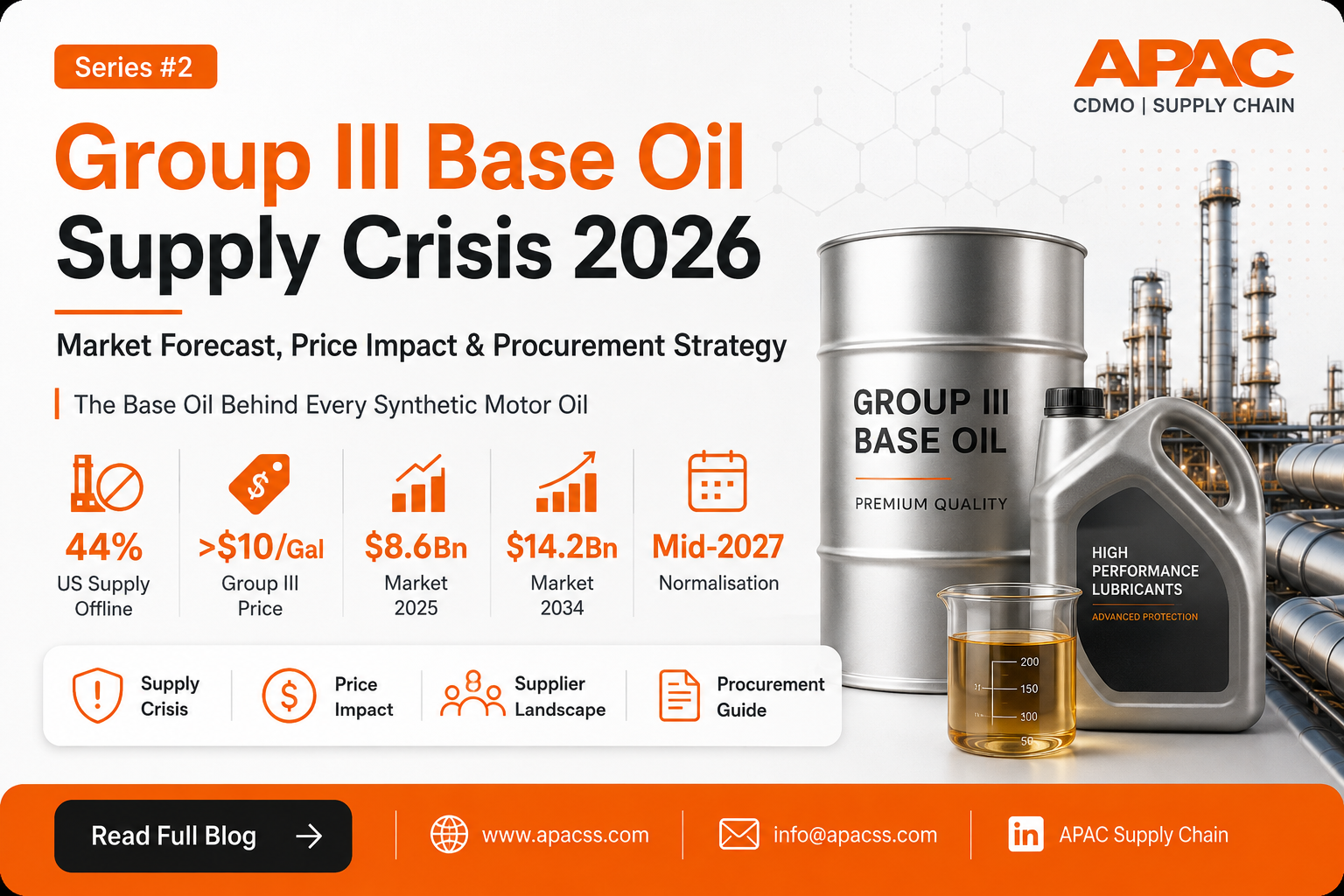
Group III Base Oil Supply Crisis 2026: Market Forecast, Price Outlook & Strategic Procurement Guide
⚠ Active Supply Crisis: The Strait of Hormuz closure (February 28, 2026) has removed 44% of US Group III base oil supply from the market. Prices have risen above $10/gallon — nearly double pre-crisis levels. ILMA (Independent Lubricant Manufacturers Association) officially stated the market will not normalise until at least mid-2027. Procurement teams must act now.
In brief: Group III base oil is the highly refined petroleum base stock (Viscosity Index ≥120, sulfur <0.03%) that makes up 75–98% of every modern synthetic motor oil. The 2026 Iran war and Strait of Hormuz blockade triggered a simultaneous three-way supply disruption that ILMA describes as a “global base oil supply crisis.” The global Group III market was valued at $8.6 billion in 2025 and is projected to reach $14.2 billion by 2034. For procurement professionals, lubricant manufacturers, and industrial buyers, this guide covers everything you need to know and act on right now.
1. What Is Group III Base Oil?
Most people fill their car with synthetic motor oil and think nothing of what is inside it. Supply chain professionals need to understand what they are actually buying — and why, right now, the supply of the most critical ingredient has collapsed.
Group III base oil is a highly refined petroleum base stock produced through a severe hydrocracking process that elevates purity, thermal stability, and oxidation resistance to levels that Group I and Group II base oils cannot achieve. It is defined by a Viscosity Index (VI) of 120 or above and sulfur content below 0.03% — the result of a refining process that removes virtually all impurities from the base petroleum feedstock.
Key fact for procurement teams: Because base oil is 75–98% of the finished lubricant product — and the carrier for the additives that make up the rest — even moderate base oil price moves translate directly and immediately into finished-lubricant cost. There is nowhere to absorb a $5+/gallon price increase in the lubricant value chain.
2. The 2026 Supply Crisis: Three Problems, One Molecule
The 2026 Group III base oil supply crisis is not the result of a single event. It is the convergence of three simultaneous disruptions — each of which closes off the typical safety valve for the others. The Independent Lubricant Manufacturers Association (ILMA) described it precisely: “This is not a single supply issue. It is three problems happening at once — and each one closes off typical alternatives.”
ILMA Official Statement (May 2026): “The US base oil market could remain under sustained pressure through at least 2027. Members are preparing for continued supply constraints across Groups II, III and IV, along with escalating costs throughout the supply chain — including transportation, insurance and logistics.”
3. Global Market Size & Forecast 2025–2034
Pre-crisis forecasts established the structural growth trajectory of the Group III base oil market. The 2026 supply disruption has added a demand-side premium to these numbers — scarcity and price elevation are accelerating the value of available supply even as volumes contract.
| Market Segment | 2025 Value | 2026 Value | 2034 Forecast | CAGR | Source |
|---|---|---|---|---|---|
| Group III Base Oil (global) | $8.6 Billion | Elevated by crisis | $14.2 Billion | 5.7% | DataIntelo, Apr 2026 |
| Global Base Oil Market (all groups) | $44.2 Billion | $45.4 Billion | $58.2 Billion | 3.1% | Fortune Business Insights, 2026 |
| Base Oil Market (alt. estimate) | $37.6 Billion | — | $56.0 Billion | 5.1% | SkyQuestTT, 2026 |
| Group III Base Oil (alt. estimate) | $19.1 Billion | — | $30.2 Billion | 5.0% | Verified Market Reports, 2026 |
| Asia Pacific Base Oil Market | Leading region (43.8% share) | $11.62 Billion | $20.27 Billion | 5.72% | Verified Market Reports, 2026 |
The structural demand drivers behind these forecasts remain fully intact and are, in fact, accelerating due to the crisis. Regulatory mandates — including EU Euro 7, US API SP, and ACEA C5/C6 — are forcing a continued structural transition from Group I to Group III base stocks across all major markets. This transition was already underway before the supply crisis and will continue regardless of geopolitical resolution.
Market structure shift: In 2025, Group I accounted for approximately 22.4% of global base oil production, down from over 40% a decade ago. Group II expanded to 38.2% share and Group III reached 20.6%. This structural upgrade toward higher-performance base stocks is being accelerated by API and ILSAC specification upgrades that effectively exclude Group I from most modern engine oil applications.
4. Group III Base Oil Price Trajectory: From $5.80 to Over $10/Gallon
The price impact of the 2026 supply crisis has been severe, rapid, and multi-layered. Understanding the price timeline is essential for procurement teams modelling their cost exposure.
| Date / Period | Group III Price ($/gallon) | Event |
|---|---|---|
| January 2026 | ~$5.80 | Pre-crisis baseline |
| February 28, 2026 | Rising | Strait of Hormuz blockade begins |
| March 2026 | ~$7.80 | Force majeure declarations; first major price hike round |
| April 2026 | ~$9.20 | South Korean export caps; second and third price hike rounds |
| May 2026 | >$10.00 | Fourth price increase round (AOCUSA/Highline Warren +$3.00/gallon on Group III) |
| June–December 2026 (forecast) | $11.00–$13.00+ | Continued deterioration forecast by ICIS (Amanda Hay, ICIS Global Base Oils Lead) |
Industry analyst Amanda Hay, Global Lead for Base Oils at ICIS, confirmed that Group III prices have climbed above $10/gallon — historically high levels — and that global supply levels are expected to “deteriorate rapidly through 2026,” with the market remaining undersupplied through 2027. Tom Glenn, publisher of JobbersWorld and a longtime lubricant industry analyst, noted that “availability is beginning to matter as much as — and in some cases more than — price” as suppliers move to protect access to approved synthetic formulations.
End-user price impact: A typical synthetic oil change that cost $80–100 in early 2026 is now closer to $110–140 at many service shops. In a normal year, motor oil producers raise prices by 70–80 cents per gallon. In 2026, some producers have raised distributor prices by $5+ per gallon in just the first three rounds of increases alone.
5. New Capacity & CapEx: Who Is Building and When It Arrives
New Group III base oil capacity is being built — but none of it will arrive in time to resolve the 2026–2027 supply crisis. This is the most important single fact for procurement teams to understand: the production investments being made today will ease the market from 2027 onwards, not before.
| Company | Investment | Location | Expected Online | Notes |
|---|---|---|---|---|
| ExxonMobil | +8,000 bpd Group III capacity | Baytown Refinery, Texas, USA | 2027 | Confirmed August 2025; 4cSt and 6cSt grades for North America |
| Chevron | New Group III+ grade production | Pascagoula, Mississippi, USA | Q4 2026 | NEXBASE 4 XP; first US Group III+ producer; Europe distribution hubs |
| SK Lubricants | World's largest Group III plant | South Korea | Operational — export capped | >3 million MT/yr capacity; currently subject to Korean export caps |
| ADNOC | Largest single Group III producer globally | UAE | Force majeure — timeline unknown | UAE offshore access blocked by Hormuz situation |
| India (IOC / HPCL) | Group II/III capacity scaling | India | 2026–2028 | Re-refined base oil MoU (Re Sustainability + IOC, March 2026); growing alt-source |
The CapEx gap: ILMA confirmed that “new Group III capacity under development by Chevron and ExxonMobil will not come online until 2027, and existing North American producers lack the ability to offset the lost volumes.” This is the structural reason why mid-2027 is the earliest realistic normalisation date — not optimism, not pessimism, but engineering and production reality.
6. Global Supplier Landscape: Who Can Supply Alternative-Origin Group III
With Gulf-origin supply largely offline and Korean supply constrained, procurement teams need a clear map of where credible alternative-origin Group III base oil can be sourced today. The supplier landscape has three tiers of availability.
- SK Lubricants (SK Enmove)
- S-Oil Corporation
- GS Caltex
- World's largest Group III capacity
- ⚠ Export caps in place (May 2026)
- Constrained by Middle East crude
- ExxonMobil (Baytown) — 2027
- Chevron (Pascagoula) — Q4 2026
- Motiva (Shell subsidiary)
- Covers ~26% of US demand
- Cannot offset Gulf supply loss
- Priority: domestic supply security
- Sinopec Group
- PetroChina
- China Lumena New Materials
- Group II/III capacity growing
- Emerging as key alt source for Asia
- Growing export capability
- Indian Oil Corporation (IOC)
- Hindustan Petroleum (HPCL)
- Re-refined base oil scaling (2026)
- IOC + Re Sustainability MoU Mar 2026
- Fastest-growing domestic capacity
- Government priority sector
- Neste Oil (Finland)
- Repsol (Spain)
- Nynas AB (Sweden)
- Predominantly Group I / naphthenic
- Limited Group III capacity
- 72% import loss from Gulf
- ADNOC — largest single producer
- BAPCO (Bahrain)
- Shell Pearl GTL (Qatar)
- All three: offline or unable to ship
- No timeline for normalisation
- Depend on Hormuz resolution
7. Impact on End Markets: Automotive, Industrial, Defence & Agriculture
The Group III base oil crisis does not only affect motor oil consumers. It ripples through every sector that depends on high-performance lubricants — and the downstream consequences are already becoming visible in multiple industries.
| Sector | Dependence on Group III | Current Impact | Risk Level |
|---|---|---|---|
| Automotive (passenger vehicles) | Very high — all modern spec engine oils | Toyota, Nissan issued dealer rationing letters (May 2026); oil change prices up $10–40 | 🔴 High |
| Automotive (luxury / EVs) | High — Group III/IV in transmission & thermal fluids | CNBC reported luxury automakers bracing for lubricant supply impact | 🔴 High |
| Industrial manufacturing | High — hydraulic and gear oils | ILMA flagged manufacturing as critical sector; DOE coordination requested | 🔴 High |
| Defence / military | Very high — high-performance spec lubricants | ILMA letter to DOE specifically cited defence as affected sector | 🔴 Critical |
| Agriculture | High — farm equipment, tractors | ILMA flagged agriculture in DOE communication | 🟠 Medium-High |
| Transportation / logistics | Very high — commercial fleet lubricants | Fleet operators escalating procurement urgency; Overdrive (trucking) published crisis alert | 🔴 High |
| Marine | High — marine engine oils, gear oils | Freight rerouting compounding supply and demand pressure simultaneously | 🔴 High |
8. Strategic Procurement Guide: 4 Actions for Procurement Teams Right Now
The window to act before this crisis moves from a price problem to an availability problem is narrowing. Based on ILMA guidance, ICIS analysis, and supply chain intelligence, here are the four actions procurement teams must take now.
The window is closing, not opening. Every week of inaction is a week of reduced options — alternative-origin capacity is being committed, long-term contracts are being signed by competitors, and prices continue to rise. The procurement advantage goes to those who qualify suppliers and lock in contracts in June–July 2026, before the summer peak demand cycle compounds availability further.
9. How APAC Supply Chain Supports Industrial Chemical & Base Oil Procurement
APAC Supply Chain is India's leading global chemical and industrial sourcing partner, connecting verified international buyers with quality-certified manufacturers and suppliers across India, South Korea, China, and broader Asia-Pacific.
Start Your Group III Base Oil Supplier Qualification
Tell us your specifications, target market, and volume requirements. We will come back within 48 hours with verified alternative-origin supplier options.
✉ Email Our Team Explore apacss.com →10. Frequently Asked Questions
Group III base oil is a highly refined petroleum base stock with Viscosity Index ≥120 and sulfur content <0.03%, produced through severe hydrocracking. It matters because it forms 75–98% of every modern synthetic motor oil, and it is the minimum base stock required to formulate oils that meet API SP, ILSAC GF-6, and ACEA C5/C6 engine specifications mandated by virtually every vehicle manufactured since 2019. Without Group III, compliant synthetic engine oil cannot be produced.
Three simultaneous supply disruptions created the crisis. The Strait of Hormuz blockade (February 28, 2026) removed 44% of US Group III supply — from Qatar (Shell Pearl GTL), UAE (ADNOC), and Bahrain (BAPCO). South Korea, which supplies 30% of US Group III, cannot cover the gap because Korean refiners depend on Middle East crude that is itself constrained, and South Korea has introduced export caps. Group II base oil — the typical backup — is being diverted to diesel production. All three safety valves are simultaneously unavailable, leaving 74% of US Group III imports under direct stress.
Group III base oil prices exceeded $10 per gallon by May 2026, compared to approximately $5.80 per gallon before the Hormuz crisis began in late February 2026. This represents a price increase of more than $4/gallon in under 90 days. Wholesale prices have risen in four consecutive rounds of increases, with the fourth round (effective May 22, 2026) adding up to $3.00/gallon on Group III products. Industry analyst Amanda Hay of ICIS confirmed that global supply levels are expected to “deteriorate rapidly through 2026.”
ILMA (Independent Lubricant Manufacturers Association) officially stated in its May 2026 customer brief that conditions are not expected to fully normalise until at least mid-2027. ILMA specifically noted that new Group III capacity from Chevron and ExxonMobil will not come online until 2027, and existing North American producers cannot offset the lost Gulf volumes. The normalisation timeline depends on: geopolitical resolution in the Middle East, restoration of shipping through the Strait of Hormuz, repair of damaged refinery infrastructure (Pearl GTL, Qatar), and the ramp-up of new production capacity in the US and Asia.
The global Group III base oil market was valued at $8.6 billion in 2025 and is projected to reach $14.2 billion by 2034 at a CAGR of 5.7% (DataIntelo, April 2026). The broader global base oil market (all groups) was valued at $45.4 billion in 2026 and is projected to reach $58.2 billion by 2034 at a CAGR of 3.1% (Fortune Business Insights, 2026). These forecasts were established before the 2026 supply crisis and do not fully account for the price premium and demand dynamics created by the Hormuz disruption.
The primary alternative-origin producers are South Korea (SK Lubricants, S-Oil, GS Caltex — though subject to export caps in 2026), the United States (ExxonMobil Baytown, Chevron Pascagoula — limited domestic capacity covering ~26% of US demand), China (Sinopec, PetroChina), and India (Indian Oil Corporation, HPCL — with growing re-refined base oil capacity). Asia-Pacific as a region held 43.8% of global base oil market share in 2025 and is the fastest-growing alternative supply source.
The end-user impact is already visible. Toyota and Nissan issued dealer rationing letters in May 2026, limiting Genuine Oil supply to 55% of prior year volumes. A typical synthetic oil change that cost $80–100 in early 2026 now costs $110–140 at many service shops. AutoZone described the situation as potentially “the largest lubricant fluid shortage in modern US history.” ILMA expects price pressure to continue through mid-2027, affecting the entire automotive aftermarket, fleet services, and commercial transportation sectors.
For international base oil procurement, documentation should include: Certificate of Analysis (CoA) per batch confirming viscosity, viscosity index, sulfur content, and flash point; Certificate of Origin (CoO); Safety Data Sheet (SDS / MSDS); Technical Data Sheet (TDS); REACH compliance documentation (for EU shipments); API certification where applicable; and customs HS code classification documentation. For automotive OEM applications, proof of API licensing and ILSAC certification may also be required. APAC Supply Chain provides full documentation packages for all qualified suppliers in our network.
11. Conclusion
Group III base oil is among the most consequential industrial chemicals in the global supply chain — and in 2026, it is also one of the most vulnerable. The triple disruption created by the Strait of Hormuz blockade, constrained Korean refining, and Group II diversion to diesel has created a supply crisis that ILMA describes as the most severe the lubricants industry has faced in decades.
The market fundamentals are clear: a $8.6 billion Group III market growing to $14.2 billion by 2034, prices that have more than doubled in under 90 days, a mid-2027 normalisation timeline with no short-circuit, and a supplier map that has fundamentally shifted away from Gulf-origin supply toward South Korean, Chinese, and Indian alternatives. For procurement and supply chain professionals, the message is unambiguous: this is not a wait-and-see situation. The window to qualify alternative suppliers, exit spot pricing, and secure long-term supply before capacity commits elsewhere is closing in real time.
Companies that treat this as a strategic supply chain event — not a temporary price fluctuation — and act accordingly in Q2 and Q3 2026 will be significantly better positioned through the undersupplied period ahead.
If you are reviewing your Group III base oil sourcing strategy — whether for lubricant blending, industrial applications, or automotive supply chains — we welcome the conversation. Reach out to our team at info@apacss.com or explore our full industrial chemical and sourcing portfolio at www.apacss.com.


