


Benzalkonium Chloride (BKC): Complete Sourcing & Applications Guide | APAC Supply Chain
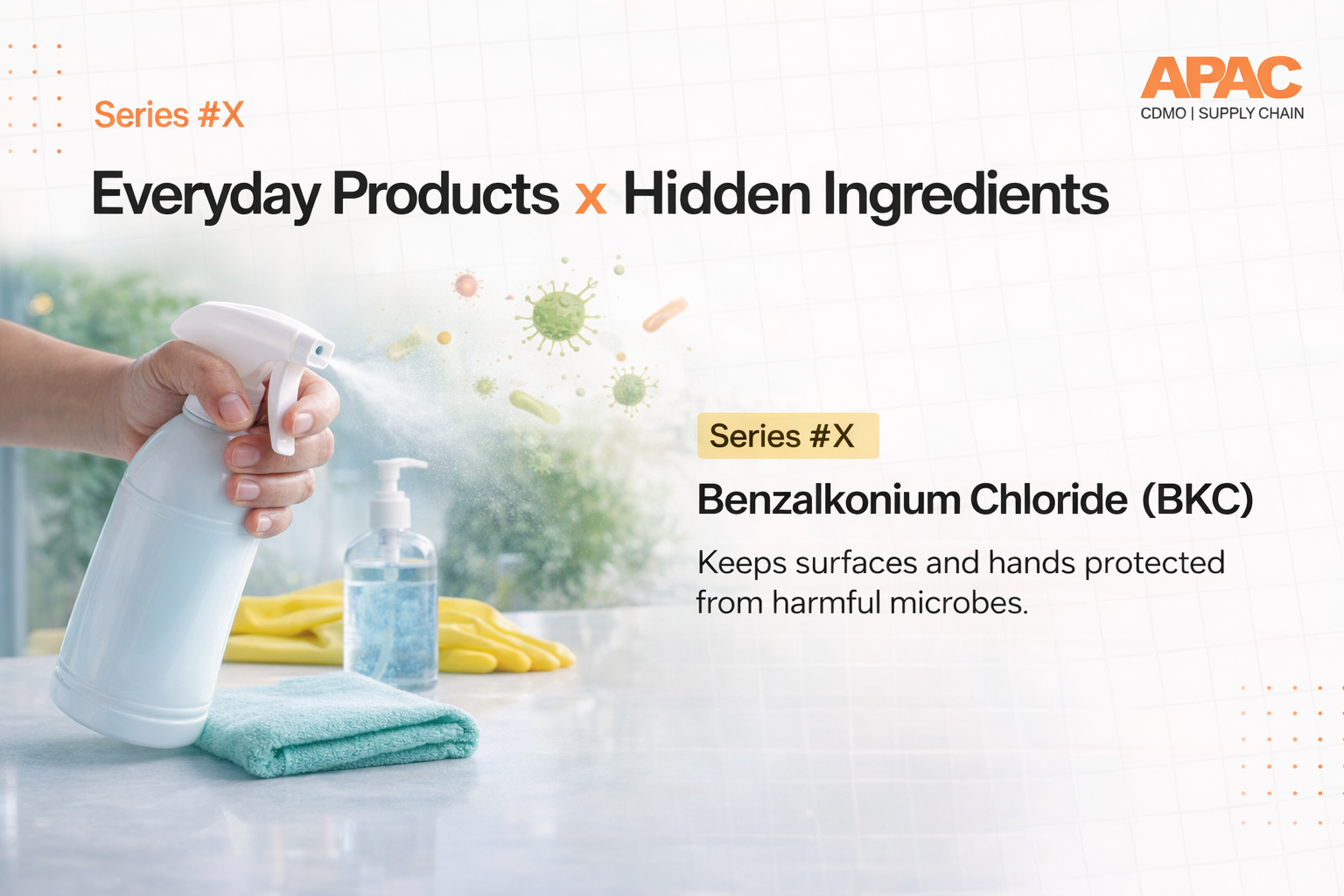
APAC Supply Chain | CDMO · Series: Everyday Products × Hidden Ingredients · March 2026
Reading time: ~7 minutes · Category: Ingredients & Raw Materials · SEO: Benzalkonium Chloride / BKC
Benzalkonium Chloride (BKC): The Invisible Antimicrobial Powering Hand Sanitisers, Pharmaceuticals & Disinfectants Worldwide
Meta Description: Benzalkonium Chloride (BKC) is one of the most widely used quaternary ammonium compounds in pharma, personal care, and industrial disinfection. Discover its chemistry, applications, grades, global supply chain, and why procurement teams across Asia trust APAC Supply Chain for bulk BKC sourcing.
Every time you use a hand sanitiser, eye drop, surface disinfectant, or antiseptic wipe — there's a very good chance benzalkonium chloride is doing the heavy lifting behind the scenes.
Benzalkonium Chloride — commonly abbreviated as BKC or BAC — is a quaternary ammonium compound (QAC) that serves as one of the most effective and versatile antimicrobial agents in global commerce. It kills bacteria, fungi, and certain viruses on contact, making it indispensable across pharmaceutical manufacturing, personal care formulation, healthcare, and industrial sanitation.
In this complete sourcing guide, we break down everything procurement managers, R&D formulators, and supply chain professionals need to know about BKC: its chemistry, commercial grades, applications, global market dynamics, and how to source it reliably at scale.
Table of Contents
- What Is Benzalkonium Chloride (BKC)?
- Chemical Properties & Commercial Grades
- How BKC Works: Mechanism of Antimicrobial Action
- Industrial & Commercial Applications
- How Benzalkonium Chloride Is Manufactured
- Global Market & Supply Chain Overview
- How to Source BKC: What Buyers Need to Know
- Why APAC Supply Chain & CDMO for BKC Procurement
- Frequently Asked Questions (FAQ)
- Conclusion
1. What Is Benzalkonium Chloride (BKC)?
Benzalkonium Chloride is a mixture of alkylbenzyldimethylammonium chloride compounds — belonging to the class of quaternary ammonium salts (QACs). It is a cationic surfactant, meaning it carries a positive charge that allows it to bind strongly to negatively charged microbial cell membranes, disrupting and destroying them.
BKC is not a single compound but a homologue mixture, typically containing alkyl chain lengths of C8 to C18. The dominant homologue in most commercial grades is the C12 (dodecyl) and C14 (tetradecyl) chain variants, which offer the best balance of antimicrobial potency and water solubility.
It was first introduced commercially in the 1930s and remains one of the most widely used preservatives and disinfectants in the world — approved for use in pharmaceutical, food-contact, personal care, and healthcare settings globally.
Key fact: BKC is listed in the WHO Model List of Essential Medicines as a skin antiseptic and is a registered active biocide under EU Biocidal Products Regulation (BPR) and US EPA guidelines.
2. Chemical Properties & Commercial Grades
Basic Chemistry
- Chemical Class: Quaternary Ammonium Compound (QAC)
- CAS Number: 8001-54-5 (mixture); 63449-41-2 (homologue mix)
- General Formula: [C₆H₅CH₂N(CH₃)₂R]Cl — where R = C8–C18 alkyl chain
- Molecular Weight: 340–448 g/mol (varies by homologue)
- Appearance: Colourless to pale yellow liquid (aqueous solution) or white powder (solid form)
- Solubility: Freely soluble in water, ethanol, and acetone
- pH (1% solution): 5.0 – 8.0
- Active Concentration: Commercially supplied as 50% or 80% aqueous solutions
Commercial Grades
- Pharmaceutical Grade (USP/BP/EP): Highest purity; used in ophthalmic preparations, nasal sprays, wound care products, and injectable preservatives. Requires full CoA with heavy metal limits and microbial testing.
- Cosmetic / Personal Care Grade: Used as a preservative and conditioning agent in skin care, hair care, and sanitiser formulations. Meets COSMOS and ISO 16128 standards where applicable.
- Disinfectant / Industrial Grade: Used in surface disinfectants, hospital-grade sanitisers, agricultural applications, and water treatment. Lower purity thresholds with focus on active content.
- Veterinary Grade: Used in animal hygiene products, teat dips, and veterinary wound care solutions.
Buyer alert: BKC is sold as 50% and 80% aqueous solutions. Always confirm active content percentage when comparing pricing — cost-per-kg of active BKC is the only fair comparison metric across suppliers.
3. How BKC Works: Mechanism of Antimicrobial Action
Understanding BKC's mode of action is essential for formulators and compliance professionals. Its antimicrobial efficacy is driven by a straightforward but highly effective electrostatic mechanism:
Step 1 — Adsorption
The positively charged nitrogen head of BKC is electrostatically attracted to the negatively charged surface of bacterial and fungal cell membranes, causing rapid adsorption onto the microbial surface.
Step 2 — Membrane Disruption
Once adsorbed, the hydrophobic alkyl chain inserts into the lipid bilayer of the cell membrane, destabilising its structure, increasing permeability, and causing leakage of intracellular contents — including ions, proteins, and nucleotides.
Step 3 — Cell Death
The resulting loss of osmotic balance, enzyme inactivation, and structural collapse leads to rapid cell death. BKC is bactericidal, fungicidal, and virucidal against enveloped viruses (including coronaviruses, influenza, and RSV) at appropriate concentrations.
Formulation note: BKC efficacy is reduced by anionic surfactants, high organic load, and hard water. Formulators should conduct compatibility testing when combining with other actives or excipients. Concentration, pH, and contact time are the three critical efficacy variables.
4. Industrial & Commercial Applications
BKC's broad-spectrum antimicrobial activity and excellent formulation compatibility make it a cornerstone active across multiple industries:
Pharmaceutical & Healthcare
- Preservative in multi-dose ophthalmic solutions (eye drops) — one of its most critical pharma applications
- Antiseptic ingredient in wound care products, surgical scrubs, and antiseptic liquids
- Preservative in nasal sprays, ear drops, and topical pharmaceutical formulations
- Hospital-grade surface disinfectants and instrument sanitisers
- Active ingredient in pre-operative skin disinfection solutions
Personal Care & Cosmetics
- Preservative in hand sanitisers, wet wipes, and antibacterial soaps
- Conditioning agent in hair care products — reduces static, improves combability
- Active in toner, micellar water, and skin care formulations requiring antimicrobial protection
- Preservation of baby care products and intimate hygiene washes
Industrial & Institutional Disinfection
- Food processing and food-contact surface disinfection (at approved concentrations with post-rinse)
- Cooling tower water treatment and algae/biofilm control
- Swimming pool and recreational water sanitation
- Textile and paper industry — mould prevention during processing
- Hard surface disinfectants for hotels, hospitals, and institutional cleaning
Agriculture & Veterinary
- Livestock housing disinfection and bio-security protocols
- Teat dip formulations for dairy cattle hygiene
- Horticulture: fungicide and bactericide for greenhouse and propagation environments
- Aquaculture pond treatment for microbial load management
5. How Benzalkonium Chloride Is Manufactured
BKC is synthesised via a well-established quaternisation reaction — a process that has been refined over decades for high yield, consistency, and scalability:
Core Synthesis Route
The reaction involves the condensation of a long-chain tertiary amine (dimethylalkylamine, where alkyl = C8–C18) with benzyl chloride in the presence of heat. This quaternisation reaction yields the ammonium salt — benzalkonium chloride — as the final product.
The alkyl chain distribution in the final product is determined by the feedstock mixture used — coconut-derived amines (giving predominantly C12/C14 homologues) are most common for pharmaceutical and personal care grades, while tallow-derived amines (C16/C18) are used in industrial grades.
Post-Synthesis Processing
After synthesis, the crude BKC is purified, pH-adjusted, and diluted to standard commercial concentrations (50% or 80% active in water). Pharmaceutical grades undergo additional testing for heavy metals, colour, residual solvents, and microbial purity before release.
Supply chain note: The key raw material — benzyl chloride — is a controlled precursor in several jurisdictions due to its dual-use potential. Buyers and suppliers must ensure full regulatory compliance with import/export documentation for this starting material, particularly for cross-border procurement in South Asia and Southeast Asia.
6. Global Market & Supply Chain Overview
The global benzalkonium chloride market was valued at approximately USD 620 million in 2024 and is projected to reach USD 920 million by 2030, growing at a CAGR of approximately 6.5% — driven by heightened hygiene awareness post-COVID-19, expanding pharmaceutical manufacturing in Asia, and rising institutional disinfection standards globally.
Key Market Dynamics
- Post-pandemic demand floor: COVID-19 permanently elevated baseline demand for BKC across hygiene and healthcare — demand has not returned to pre-2020 levels and is unlikely to.
- India as a growth engine: India's domestic pharma and FMCG manufacturing boom is driving significant growth in BKC consumption — particularly for ophthalmic, antiseptic, and personal care applications. India is also emerging as a secondary producer for regional supply.
- China dominance in production: Chinese manufacturers — particularly in Shandong and Jiangsu provinces — produce the majority of global BKC supply. Supply disruptions from environmental inspections or raw material shortfalls have caused notable price spikes in recent years.
- Regulatory tightening: The EU and US FDA are increasing scrutiny on QAC preservatives, including BKC, in rinse-off personal care products and food-contact disinfectants. Buyers in regulated markets must monitor evolving maximum use limits.
- Grade premiumisation: Pharmaceutical and EP/USP-grade BKC commands a 30–50% price premium over industrial grade, and demand for documented, traceable pharma-grade supply is growing faster than commodity-grade demand.
7. How to Source Benzalkonium Chloride: What Buyers Need to Know
Sourcing BKC at commercial scale involves several critical decisions that go beyond price. Here are the factors that separate reliable procurement from costly mistakes:
Define Active Concentration Upfront
BKC is sold as 50% and 80% solutions. Always specify the required active content in your purchase order. A lower-priced 50% solution is not cheaper than an 80% solution if you compare cost-per-unit of active ingredient. Confusion on this point is one of the most common sourcing errors.
Homologue Distribution Specification
For pharmaceutical and ophthalmic applications, the alkyl chain distribution (C12:C14 ratio) is critical and must be specified. Different homologue profiles affect antimicrobial potency and ocular tolerability. Request a homologue distribution report from your supplier for pharma-grade orders.
Full Certificate of Analysis (CoA)
A compliant CoA for pharmaceutical-grade BKC should include: assay (active content %), pH, colour (APHA/Hazen scale), specific gravity, heavy metals (As, Pb, Hg), residue on ignition, and microbial limits. Reject any supplier who cannot provide batch-specific CoAs.
Packaging & Compatibility
BKC solutions are corrosive to certain metals and incompatible with anionic surfactants. Ensure packaging is in HDPE drums (25 kg, 200 kg) or IBC tanks for bulk orders. Avoid galvanised or aluminium containers.
Regulatory Documentation for Import
For import into India, Middle East, or Southeast Asian markets, confirm that your supplier provides the necessary export permits (especially for benzyl chloride-derived products), MSDS, and country-of-origin certificate. REACH compliance documentation is required for EU import.
Supplier Audit & GMP Status
For pharma-grade BKC, always verify that the manufacturing facility holds current GMP certification from a recognised authority (CDSCO, FDA, EDQM CEP). Request the Drug Master File (DMF) reference if the BKC will be used in a regulated drug product.
APAC insight: We source BKC from pre-qualified, GMP-certified manufacturers across China and India, with full homologue profiling and pharmacopoeial documentation as standard. Our team handles end-to-end logistics and import compliance for buyers across South Asia, Southeast Asia, and the Middle East.
8. Why APAC Supply Chain & CDMO for BKC Procurement
At APAC Supply Chain | CDMO, we specialise in sourcing and supplying pharmaceutical actives, excipients, and specialty chemicals across the Asia-Pacific region. Here's why procurement teams choose us for benzalkonium chloride:
- Pharma & industrial grades stocked: We supply USP, BP, EP pharmaceutical grades and industrial-grade BKC (50% and 80% solutions) from audited, GMP-certified manufacturers.
- Homologue profiling on request: Full C12/C14 distribution reports available for ophthalmic and sensitive pharmaceutical applications.
- Competitive multi-origin pricing: Direct manufacturer relationships in China and India ensure market-best pricing without sacrificing documentation standards.
- End-to-end logistics: Sourcing, quality verification, export documentation, customs clearance support, and last-mile delivery across India and key export markets.
- CDMO capabilities: Contract formulation of BKC-based products — including antiseptic solutions, ophthalmic preservatives, sanitiser concentrates, and surface disinfectant formulations — for brands and private label customers.
- ISO 9001:2015 Certified & EcoVadis Committed: Our quality management systems and sustainability ratings give regulated-market buyers confidence in our operational standards.
Ready to source Benzalkonium Chloride?
Contact our procurement team at ibd@apacss.com or visit www.apacss.com for product specifications, CoA samples, and pricing.
9. Frequently Asked Questions (FAQ)
What is benzalkonium chloride used for?
BKC is used as an antimicrobial preservative and active disinfectant across pharmaceuticals (eye drops, nasal sprays, wound care), personal care (hand sanitisers, wet wipes, antiseptic soaps), institutional disinfection, water treatment, agriculture, and veterinary applications. It is one of the most versatile biocidal active ingredients commercially available.
Is benzalkonium chloride safe for human use?
BKC is approved for human use at regulated concentrations by the US FDA, EU SCCS, and global pharmacopoeias. At typical use levels (0.01%–0.1% in topical and ophthalmic products), it is considered safe and effective. At higher concentrations it is corrosive and must be handled with appropriate PPE. Buyers should always consult current regulatory limits for their specific application and market.
What is the difference between BKC 50% and BKC 80%?
The percentages refer to the active benzalkonium chloride content in the aqueous solution. BKC 80% contains 800 g of active BKC per kilogram of solution, while BKC 50% contains 500 g per kilogram. The 80% grade is more concentrated and cost-efficient for bulk industrial use; the 50% grade is more common in pharmaceutical and personal care applications due to easier handling and dilution. Always compare pricing on an active-content basis.
What is the shelf life of benzalkonium chloride?
BKC solutions are chemically stable and typically have a shelf life of 2–3 years when stored in sealed HDPE containers away from direct sunlight, extreme heat, and incompatible materials (particularly anionic surfactants and oxidising agents). The product should be kept tightly sealed to prevent contamination and concentration changes due to evaporation.
Does BKC kill COVID-19 and other viruses?
Yes. BKC is effective against enveloped viruses, including SARS-CoV-2 (COVID-19), influenza, RSV, and herpes viruses at appropriate concentrations (typically ≥0.1% active). It is less effective against non-enveloped viruses (e.g., norovirus, adenovirus) and bacterial spores. The US EPA and European Centre for Disease Prevention and Control (ECDC) have both confirmed BKC's efficacy against SARS-CoV-2.
How do I get a sample or quotation for BKC from APAC Supply Chain?
You can request product specifications, batch CoA, and samples by emailing our team at ibd@apacss.com. We supply pharmaceutical, cosmetic, and industrial grade BKC in 50% and 80% concentrations. Minimum order quantities and pricing are available on request.
Is benzalkonium chloride banned or restricted anywhere?
BKC is subject to concentration limits in many markets. The EU restricts BKC in rinse-off cosmetics at 0.1% and in leave-on cosmetics at 0.05%. The US FDA banned BKC from OTC consumer antiseptic wash products in 2016 citing insufficient evidence for safety/efficacy in that specific use — however it remains approved in healthcare antiseptics, ophthalmic products, and industrial disinfectants. Buyers should always verify current regulations in their target market before formulating.
10. Conclusion
Benzalkonium Chloride is quietly one of the most important specialty chemicals in global commerce. From the eye drop preservative that keeps your ophthalmology product sterile, to the hospital disinfectant protecting surgical wards, to the hand sanitiser in your pocket — BKC is the invisible antimicrobial behind billions of daily interactions with hygiene and healthcare products.
For procurement and formulation professionals, the challenge isn't simply finding BKC — it's sourcing the right grade, concentration, and homologue profile from a supplier who can provide the documentation, consistency, and regulatory support that modern manufacturing demands.
At APAC Supply Chain | CDMO, we combine deep supplier relationships across Asia with rigorous quality management (ISO 9001:2015) and sustainability accountability (EcoVadis Committed) to give buyers across India, Southeast Asia, and the Middle East a procurement partner they can rely on.
If you are reviewing your BKC sourcing strategy or require pharmaceutical-grade supply with full documentation, we'd welcome the conversation. Reach out at ibd@apacss.com or explore our full ingredient portfolio at www.apacss.com.


