


APAC Chemical & Pharma Sourcing: Cut Costs by 38% with 2,400+ GMP-Certified Suppliers | APAC Sourcing Solutions
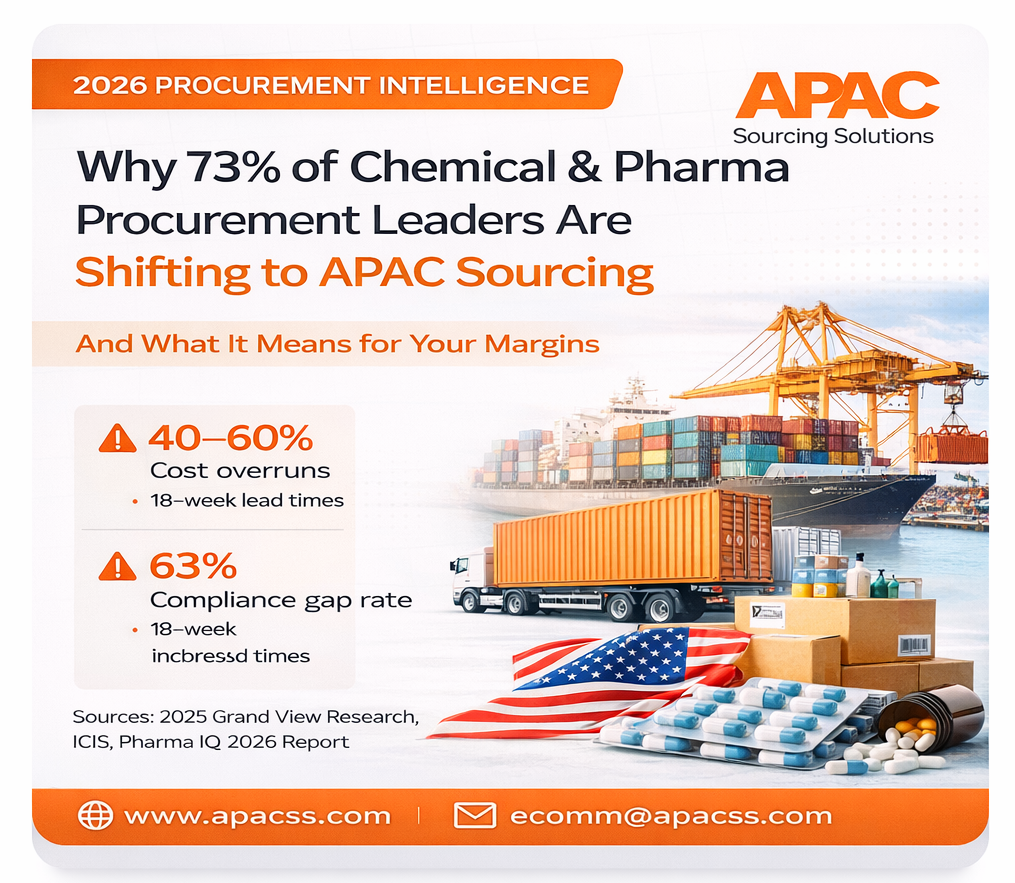
Why 73% of Chemical & Pharma Procurement Leaders Are Shifting to APAC Sourcing — And What It Means for Your Margins
40–60% cost overruns. 18-week lead times. A 63% compliance gap rate. The traditional supply chain model is bleeding procurement budgets dry. Here is the APAC sourcing model that fixes all three.
73% of chemical and pharma procurement leaders are quietly shifting their supply chains to Asia-Pacific. The ones who are not? They are still absorbing 40–60% cost overruns, waiting 18 weeks for specialty chemicals, and navigating a compliance gap rate that affects nearly two-thirds of the industry. The APAC sourcing model was built to fix exactly that.
The Brutal Truth About Traditional Chemical & Pharma Supply Chains
For decades, chemical and pharma procurement operated on a fragmented multi-vendor model — sourcing from multiple Western suppliers, managing separate logistics chains, and dealing with compliance documentation as an afterthought. That model made sense in a world of stable geopolitics, predictable freight costs, and limited Asian manufacturing capability. None of those conditions exist today.
The procurement data from 2025 and 2026 paints a stark picture of what fragmented sourcing is actually costing chemical and pharma businesses:
These are not edge-case scenarios. They represent the median experience of procurement teams operating without a consolidated Asia-Pacific sourcing strategy. The data is the reason 73% of procurement leaders are actively shifting — not considering, actively executing — a move to APAC-centric supply chains.
What Is the APAC Sourcing Model?
APAC Sourcing Solutions operates as a single-window procurement partner for chemical and pharma companies. Rather than managing dozens of fragmented vendor relationships across different regulatory environments and logistics networks, clients access a single integrated model that covers the entire procurement lifecycle — from supplier identification to last-mile delivery.
The model works across four integrated stages:
Identify — Qualified API & Chemical Supplier Matching
Using an AI-powered matching system against a database of 2,400+ pre-vetted GMP-certified suppliers across China, India, South Korea, and South-East Asia. Every supplier is pre-screened for capacity, certifications, and export track record before shortlisting.
Audit — GMP / ISO / REACH Compliance Verification
Structured compliance audits covering GMP certification, ISO 9001/14001, REACH registration, FDA/EMA/CDSCO/ICH Q7 documentation, and physical sample testing. Compliance is verified before any commercial engagement — not after.
Negotiate — Volume Contracts & Tiered Pricing
Commercial negotiation covering MOQ structuring, volume-tiered pricing, Incoterms selection, payment terms, and long-term supply agreement frameworks. Clients benefit from consolidated volume leverage across the APAC network — not just their individual order volumes.
Deliver — Last-Mile Logistics & Full Documentation
End-to-end logistics management covering sea and air freight, customs clearance, import documentation, CoA and MSDS delivery, and real-time shipment tracking. 99.1% on-time delivery rate with vetted logistics partners.
Regulatory support across FDA, EMA, CDSCO and ICH Q7 — plus real-time supplier performance dashboards for every active procurement relationship. One point of contact. One accountability chain. No more managing six vendors for one ingredient.
The APAC Chemical Market: The Numbers That Drive the Decision
The strategic shift to APAC sourcing is not a trend — it is a structural response to a market that now dominates global chemical and pharma manufacturing capacity. The numbers behind the Asia-Pacific chemical market make the procurement case on their own.
Sources: ICIS, Grand View Research, Pharma IQ 2025 Report
What Can You Source Through APAC Sourcing Solutions?
The APAC Sourcing Solutions network spans the full spectrum of chemical and pharma raw material categories — from regulated pharmaceutical APIs to bulk industrial chemicals. The four primary procurement categories and their corresponding APAC advantages are:
Pharma Manufacturers — APIs & Excipients
Active Pharmaceutical Ingredients, pharmaceutical excipients, and drug intermediates sourced at 30–45% lower cost with full GMP documentation, CoA, and ICH Q7 compliance.
30–45% cost reductionSpecialty Chemicals & Custom Synthesis
Custom synthesis and contract manufacturing from ISO 9001-certified APAC facilities. Full intellectual property protection frameworks and scale-up capability from lab to commercial volumes.
Competitive pricing + IP protectionAgrochemical Companies — Technical Grade
Technical grade and formulation-ready agrochemical ingredients with full regulatory support across target market requirements. Traceable supply chains with REACH and CIPAC compliance.
Full regulatory coverageR&D Labs & CROs — Fine Chemicals
Small-batch fine chemicals and reference standards with Certificate of Analysis and Mass Spectrometry data. Fast turnaround sourcing for early-stage research and clinical development.
Fast turnaround · CoA + MS dataProducts Available Through the APAC Network
From Inquiry to Delivery: The 5-Step APAC Sourcing Process
One of the most common procurement concerns about Asia-Pacific sourcing is process complexity — the perception that managing suppliers across China, India, and SEA requires significant internal resources and expertise. The APAC Sourcing Solutions model is built specifically to eliminate that complexity through a structured 5-step process:
Requirements Scoping
Define technical specifications, quality standards, regulatory certifications, target volumes, and timelines. This scoping session — typically completed within 24–48 hours — forms the brief for all subsequent supplier matching activity.
AI-Powered Supplier Matching
An AI-assisted shortlist is generated from the network of 2,400+ vetted APAC suppliers, filtered by specification match, certification status, export track record, lead time capability, and current production availability.
Compliance Audit & Sample Testing
GMP, ISO, and REACH verification is conducted on shortlisted suppliers. Physical samples are tested against specification before any commercial commitment. Audit reports are provided to the client for internal compliance records.
Commercial Negotiation
MOQ structuring, volume-tiered pricing, Incoterms selection, and payment terms are negotiated on the client's behalf. Long-term supply agreements are structured where appropriate to lock pricing and secure allocation.
Logistics, Customs & Documentation
Sea and air freight management, customs clearance, import documentation, CoA and MSDS delivery, and real-time tracking through to final delivery. The 99.1% on-time delivery rate is maintained through pre-vetted logistics partners on every corridor.
Traditional Sourcing vs. APAC Sourcing: A Direct Comparison
The procurement decision between maintaining a traditional multi-vendor sourcing approach and consolidating through an APAC single-window model ultimately comes down to quantifiable metrics. The comparison is stark:
| Procurement Factor | Traditional Sourcing | APAC Sourcing Solutions |
|---|---|---|
| Average Lead Time | 18 weeks | 15 days |
| Total Cost Premium | 2.3x higher | 38% savings |
| Compliance Gap Rate | 63% of firms | Pre-audited suppliers |
| Supplier Network | Fragmented, unvetted | 2,400+ GMP-certified |
| Regulatory Coverage | Varies by vendor | FDA, EMA, CDSCO, ICH Q7 |
| On-Time Delivery | Inconsistent | 99.1% rate |
| Documentation | Multiple formats, gaps | Standardised package |
| Internal Resources Required | High — multiple vendor managers | Single point of contact |
Regulatory Coverage: FDA, EMA, CDSCO & ICH Q7
For pharma and specialty chemical procurement, regulatory compliance is not a checkbox — it is a business-critical requirement that affects product approval, market access, and manufacturing authorisation. The APAC Sourcing Solutions compliance framework is built around the four primary regulatory systems that govern chemical and pharma procurement globally:
- FDA (US Food & Drug Administration) — 21 CFR Part 211 GMP compliance for pharmaceutical manufacturers supplying the US market. Supplier documentation includes FDA registration numbers and inspection history.
- EMA (European Medicines Agency) — EMA GMP certification and EU REACH compliance for suppliers servicing European pharma manufacturers and distributors.
- CDSCO (Central Drugs Standard Control Organisation) — Indian regulatory compliance for pharma ingredients, critical for supply chains involving Indian API manufacturers supplying global markets.
- ICH Q7 — The international GMP guideline for Active Pharmaceutical Ingredients. Every API supplier in the APAC network is audited against ICH Q7 requirements as a baseline condition for onboarding.
Why Now? The 2026 Procurement Imperative
The structural case for APAC sourcing has been building for years. But 2026 has introduced a set of compounding factors that make the shift urgent rather than strategic:
- Supply chain concentration risk — Recent global disruptions have exposed the fragility of single-region sourcing. Procurement leaders are actively diversifying into APAC as a resilience strategy, not just a cost strategy.
- APAC manufacturing capacity expansion — India's PLI (Production-Linked Incentive) scheme and China's chemical industry consolidation have created a generation of large, export-ready, GMP-certified manufacturers that did not exist a decade ago.
- Regulatory maturity — APAC suppliers — particularly in India — now routinely carry FDA, EMA, and ICH Q7 certifications. The compliance gap that once justified Western sourcing premiums has largely closed.
- Currency and logistics arbitrage — The combination of INR and CNY competitiveness against USD and EUR, combined with maturing freight corridors, has structurally embedded the 38% cost advantage rather than making it cyclical.
- Western supply chain inflation — Energy-driven cost increases in European chemical manufacturing and US logistics constraints are widening the cost differential further, not narrowing it.
Frequently Asked Questions
Conclusion: The Procurement Window Is Open — But It Is Not Permanent
The case for APAC chemical and pharma sourcing is no longer a matter of debate among procurement professionals. The data — $1.2 trillion market, 38% cost savings, 15-day lead times, 99.1% on-time delivery — reflects a structural shift in where the world's chemical and pharmaceutical manufacturing capacity now lives.
The 73% of procurement leaders shifting to APAC are not reacting to a trend. They are responding to a permanent structural reality: Asia-Pacific is now the world's dominant chemical and pharma manufacturing base, with the regulatory credentials, quality infrastructure, and logistics capability to serve global markets compliantly and competitively.
The question for procurement teams is not whether to make the shift. It is how quickly — and with the right partner — to do so before allocation tightens and the current pricing arbitrage narrows.
Book Your Free APAC Sourcing Audit
Discuss your chemical or pharma procurement requirements with the APAC Sourcing Solutions team. What you receive in the audit: custom supplier shortlist · cost benchmarking report · compliance risk assessment.
Reach us at ecomm@apacss.com or visit www.apacss.com. We respond within 24 hours.


