


US 100% Pharma Tariff 2026: Procurement & Supply Chain Guide | APAC Supply Chain
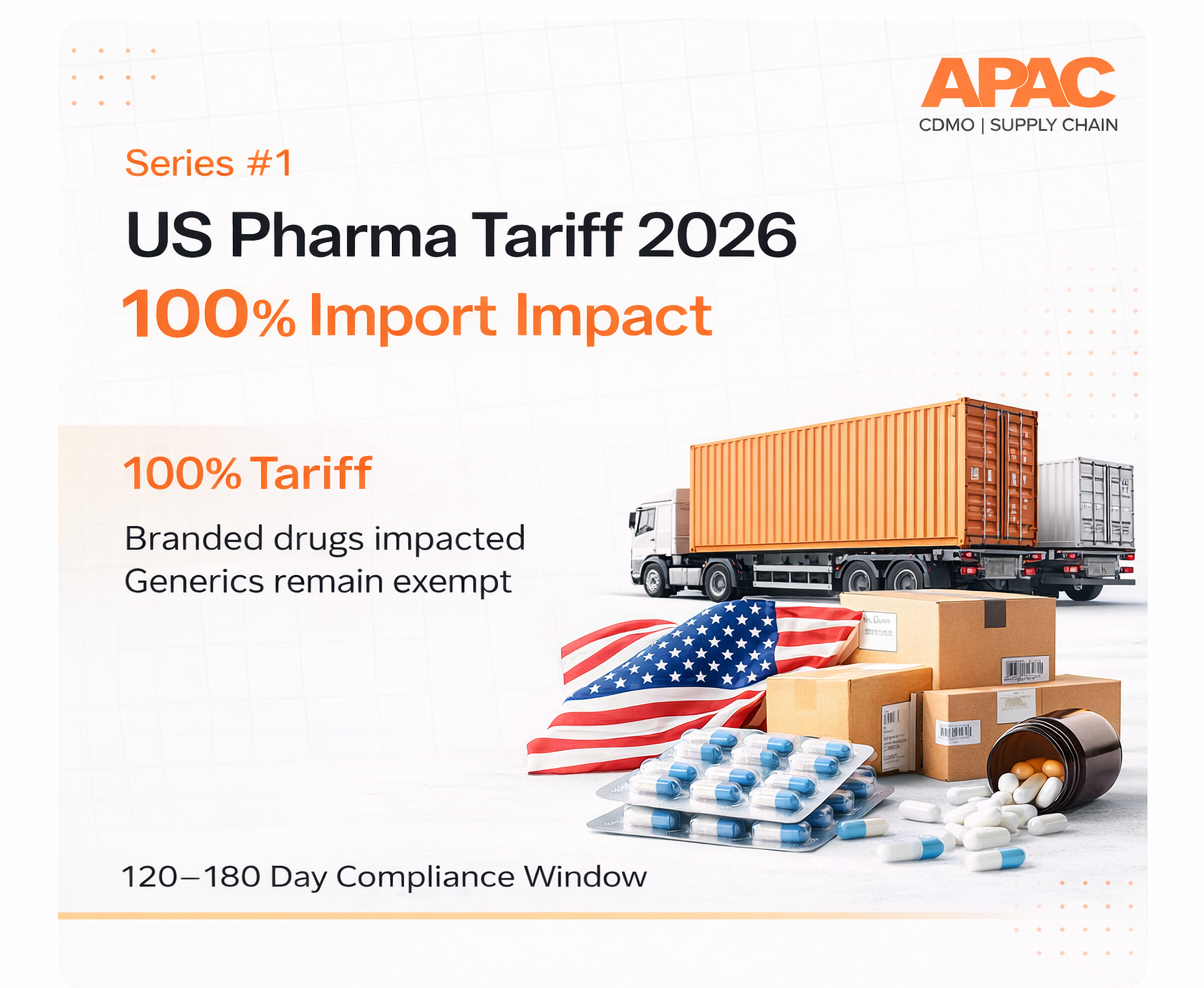
APAC Supply Chain | CDMO · Series: Global Trade & Pharma Policy · April 2026
Reading time: ~9 minutes · Category: Regulatory & Trade Policy · SEO: US Pharma Tariff 2026 / Pharmaceutical Import Tariff USA
US 100% Pharmaceutical Tariff 2026: Complete Guide for Pharma Procurement, Supply Chain & Regulatory Teams
Meta Description: The US government has announced a landmark 100% tariff framework on select branded pharmaceutical imports, with a 120-day implementation window and a Tier 2 deadline of September 29, 2026. This guide breaks down the affected drug categories, what is exempt, trade deal pathways, and what procurement and regulatory teams across Asia need to do now.
On April 2, 2026, the US government signed an executive order introducing a 100% tariff framework on select pharmaceutical imports — one of the most consequential trade policy developments the global pharmaceutical supply chain has seen in decades.
The framework specifically targets patented (branded) finished dosage forms and their Active Pharmaceutical Ingredients (APIs), with a structured two-tier compliance timeline and explicit exemptions designed to protect public health and preserve access to essential medicines.
For pharmaceutical procurement managers, regulatory affairs professionals, supply chain strategists, and formulation teams operating across Asia, the Middle East, and global markets — understanding this framework in detail is now a business-critical priority. This guide provides a complete, structured breakdown.
Table of Contents
- What Is the US 100% Pharmaceutical Tariff?
- Tier 1: Highest-Risk Drug Categories (120-Day Deadline)
- Tier 2: The 180-Day Compliance Window (Sept 29, 2026)
- What Is Exempt from the 100% Tariff?
- Trade Deal Pathways: The 10–15% Capped Rate
- Supply Chain Implications for Asia-Based Manufacturers
- Strategic Actions for Procurement & Regulatory Teams
- How APAC Supply Chain Supports Your Compliance Strategy
- Frequently Asked Questions (FAQ)
- Conclusion
1. What Is the US 100% Pharmaceutical Tariff?
The United States government has introduced a structured tariff framework specifically targeting branded pharmaceutical imports. At its core, the policy imposes a 100% tariff rate on patented finished dosage forms and their corresponding Active Pharmaceutical Ingredients (APIs) that are imported into the US market without an active trade agreement in place.
The framework operates on two compliance timelines — a 120-day window for the highest-impact branded drug categories, and a 180-day window (ending September 29, 2026) for a broader set of mid-sized manufacturers. Countries and manufacturers that enter bilateral or multilateral trade deals with the US administration access a significantly reduced capped rate of 10–15%.
Critically, the policy includes explicit carve-outs for generic drugs, orphan drugs, and critical vaccines — protecting the categories that form the backbone of everyday public health access. These exemptions reflect a calibrated approach to trade policy rather than a blanket restriction on pharmaceutical imports.
Key context: The US pharmaceutical market is the world's largest, valued at over USD 600 billion annually. Approximately 90% of prescriptions dispensed in the US are generic drugs, and the US also imports a significant share of its branded drug supply from Europe, Asia, and other regions. This tariff framework creates meaningful compliance and commercial implications for any manufacturer or supplier with US market exposure.
2. Tier 1: Highest-Risk Drug Categories (120-Day Deadline)
The 120-day implementation window applies to the highest-profile patented (branded) drug categories. These are the categories actively under the US administration's pricing negotiation agenda, and manufacturers that do not reach a trade deal within this window face the full 100% tariff rate. The four primary Tier 1 categories are:
Weight Loss & Diabetes — GLP-1 Agonists
High-demand GLP-1 receptor agonists — including branded medications such as Zepbound (tirzepatide) and Wegovy (semaglutide) — are a primary focus of the administration's pharmaceutical pricing agenda. The global GLP-1 market has experienced exponential growth, with demand significantly outpacing supply in recent years. The tariff framework positions these products as central to US-origin manufacturing incentive discussions.
Oncology — Branded Immunotherapies & Chemotherapies
Branded immunotherapy agents and chemotherapy drugs that rely on high-cost imported biological components are included in the Tier 1 framework. This includes checkpoint inhibitors, monoclonal antibody-based therapies, and other biological oncology treatments sourced or manufactured with imported APIs or biological starting materials.
Autoimmune — Biologics
Biological medicines used for autoimmune conditions including Crohn's disease and Rheumatoid Arthritis are in scope. Key examples include established blockbuster biologics such as Stelara (ustekinumab) and Humira (adalimumab). These are complex, high-value products with global supply chains that span multiple manufacturing and sourcing geographies.
Cardiovascular — Next-Generation Medications
New-generation blood thinners (anticoagulants) and cholesterol-lowering medications — particularly the newer branded classes beyond generic statins — fall within the Tier 1 scope. These represent high-value branded segments of the cardiovascular therapeutic area.
Procurement implication: Manufacturers supplying APIs or finished dosage forms to US-market branded products in these four categories should immediately audit their US customer exposure, current import volumes, and trade deal eligibility. The 120-day window is operationally short for complex regulatory and commercial negotiations — early engagement is critical.
3. Tier 2: The 180-Day Compliance Window (Deadline: September 29, 2026)
Smaller manufacturers and companies with lower pharmaceutical import volumes into the US market have been provided an extended compliance window of 180 days from the April 2, 2026 executive order. This places the Tier 2 compliance deadline at September 29, 2026.
The Tier 2 list encompasses hundreds of mid-sized pharmaceutical firms that produce specialised patented medications — including niche branded generics, rare disease treatments still under patent, and speciality pharmaceutical products with lower US import volumes than the Tier 1 blockbuster categories.
Key Tier 2 Compliance Milestones
- April 2, 2026: Executive order signed; 180-day clock begins for Tier 2 manufacturers
- May–June 2026: Recommended window to initiate trade deal discussions or compliance strategy review
- July–August 2026: Final opportunity to complete documentation, classification review, and trade negotiation
- September 29, 2026: Tier 2 compliance deadline — 100% tariff rate applies to non-compliant imports after this date
Regulatory note: Manufacturers should not wait until close to the September 29 deadline to begin classification review. Determining whether a specific product falls under Tier 1 or Tier 2 — and whether it qualifies for exemption — requires a detailed review of patent status, HS code classification, and US import volume records. This process should begin immediately.
4. What Is Exempt from the 100% Tariff?
The US administration has explicitly excluded several pharmaceutical categories from the 100% tariff framework to prevent immediate public health disruption. These exemptions are significant and reflect a deliberate policy decision to protect essential medicine access while targeting branded drug pricing.
Generic Drugs — Exempt for a Minimum of One Year
Standard off-patent generic medications are explicitly excluded from the 100% tariff for at least one year. This is the single most consequential exemption — generic drugs account for approximately 90% of all prescriptions dispensed in the United States. For India, which is among the world's largest exporters of generic pharmaceuticals to the US, this exemption provides significant near-term protection for the dominant segment of bilateral pharma trade.
Orphan Drugs — Fully Exempt
Treatments for rare diseases designated under the US Orphan Drug Act are fully excluded from the tariff framework. These products serve small, medically vulnerable patient populations, and their exclusion reflects the administration's commitment to preserving rare disease treatment access regardless of trade dynamics.
Critical Vaccines — Fully Exempt
Standard paediatric vaccines and seasonal influenza vaccines are explicitly excluded from the tariff framework. This exemption covers the core immunisation schedule products essential to US public health infrastructure, ensuring that vaccination programmes remain unaffected by trade policy changes.
Summary of exemptions at a glance:
✔ Generic drugs (off-patent) — Exempt for minimum 1 year (~90% of US prescriptions)
✔ Orphan / rare disease drugs — Fully exempt
✔ Critical vaccines (paediatric + flu) — Fully exempt
✔ Trade-deal nation imports — Capped at 10–15% (not 100%)
5. Trade Deal Pathways: The 10–15% Capped Rate
A central mechanism of the US tariff framework is the trade deal pathway — the provision that allows countries and manufacturers who enter bilateral or multilateral trade agreements with the US to access a significantly reduced capped tariff rate of 10–15%, rather than the full 100% rate applied to non-deal imports.
Countries that have already reached or are close to a trade deal arrangement with the US — including the European Union, the United Kingdom, Japan, South Korea, and Switzerland — are confirmed to face the 10–15% capped rate. This is a commercially significant differential that creates strong incentives for both national governments and individual pharmaceutical manufacturers to pursue active trade engagement.
Countries at 10–15% Capped Rate (Trade Deal)
- European Union: Covers EU-origin pharmaceutical exports to the US market
- United Kingdom: Post-Brexit, independently negotiated trade arrangement
- Japan: Long-standing US trade and security partner; pharmaceutical trade framework in place
- South Korea: Existing KORUS FTA framework provides the basis for the capped rate
- Switzerland: Major pharmaceutical manufacturing hub; Novartis, Roche origin country
Strategic consideration: For manufacturers in countries not currently on the trade-deal list, the most time-critical action is to understand the trade deal process and engage with their home country's trade ministry or pharmaceutical industry association. Individual company-level engagement alongside national-level trade discussions creates the strongest pathway to accessing the capped rate. The 120 and 180-day deadlines make early engagement a commercial imperative.
6. Supply Chain Implications for Asia-Based Manufacturers
India
India is the world's largest supplier of generic pharmaceuticals to the US — supplying approximately 40% of generic medicines consumed in the American market. The one-year generic drug exemption provides critical near-term protection for this dominant trade corridor. However, Indian manufacturers operating in the branded/patented API or finished dosage form space — particularly those supplying APIs to US brand holders — need to assess their specific product exposure carefully. The broader policy environment also warrants monitoring for any changes to the exemption window beyond the initial one-year period.
China
China is a major global API manufacturer, including for branded drug categories. Chinese API manufacturers supplying Tier 1 drug categories to the US market face direct exposure to the 100% tariff framework, given the current absence of a US-China pharmaceutical trade deal. This creates potential supply chain restructuring pressures as US branded drug manufacturers evaluate their API sourcing geography.
Southeast Asia
Countries including Indonesia, Thailand, Malaysia, and Vietnam have growing pharmaceutical manufacturing sectors. Their exposure depends heavily on the product mix — generic manufacturers benefit from the exemption, while those in specialised patented product manufacturing need to assess compliance timelines. The trade deal pathway may present opportunities for ASEAN-level engagement.
Middle East & Africa
Pharmaceutical manufacturers in Egypt, Saudi Arabia, and the UAE — many of which supply both regional and export markets — face limited direct exposure to the US tariff if their US export volumes are low. However, the secondary effects of global API supply chain restructuring (particularly if Chinese or Indian API production is redirected away from the US market) may affect ingredient availability and pricing in MEA markets over the medium term.
Did you know? The global pharmaceutical API market is valued at over USD 240 billion, with Asia-Pacific accounting for more than 60% of production. Any significant restructuring of US pharma import policy creates ripple effects across the entire global API and excipient supply chain — affecting pricing, lead times, and supplier qualification strategies for procurement teams worldwide.
7. Strategic Actions for Procurement & Regulatory Teams
Step 1 — Conduct an Immediate Product Exposure Audit
Map your current product portfolio against the tariff framework. Identify which products or APIs are: (a) in Tier 1 branded categories with the 120-day deadline, (b) in Tier 2 with the September 29 deadline, (c) eligible for exemption as generics, orphan drugs, or vaccines, or (d) manufactured in a trade-deal country eligible for the 10–15% capped rate. This audit forms the foundation of all subsequent strategic decisions.
Step 2 — Review HS Code Classifications
The tariff applicability depends heavily on the correct Harmonised System (HS) code classification of each product. Misclassification — in either direction — creates compliance risk. Engage your customs and regulatory affairs team to validate HS code assignments for all US-market products, particularly those in borderline patent status or complex formulation categories.
Step 3 — Evaluate Dual-Sourcing & Supply Chain Diversification
For APIs and ingredients currently sourced from single-country suppliers in potential high-tariff geographies, this is an appropriate time to evaluate dual-sourcing strategies. Qualifying alternative API suppliers — particularly from trade-deal geographies — reduces long-term tariff exposure and improves supply chain resilience overall.
Step 4 — Engage Trade Ministry & Industry Association Channels
Company-level advocacy combined with national-level trade engagement provides the strongest pathway to trade deal access. Engage with your home country's pharmaceutical industry association and trade ministry to understand the status of trade discussions with the US and how your products may benefit from national-level negotiations.
Step 5 — Update Procurement Contracts & Force Majeure Clauses
Review existing long-term procurement contracts for US-market pharmaceutical products. Assess whether tariff-related cost escalation triggers any contract renegotiation provisions. Update force majeure and regulatory change clauses in new contracts to provide appropriate protection against future trade policy developments.
Procurement tip: When renegotiating supplier agreements in the context of this tariff framework, always document the landed cost implications — not just the unit price. A supplier in a trade-deal country at a nominally higher per-unit cost may represent a lower total delivered cost than a non-deal country supplier subject to the 100% tariff. Model the full cost-to-market, not just the invoice price.
8. How APAC Supply Chain Supports Your Compliance Strategy
At APAC Supply Chain | CDMO, we work with pharmaceutical manufacturers, procurement teams, and supply chain professionals across India, Southeast Asia, the Middle East, and global HCR markets. In the context of this evolving tariff framework, our role is to help clients navigate supply chain complexity with category expertise, supplier intelligence, and procurement agility.
Here is how we support procurement and regulatory teams responding to the US pharma tariff framework:
- Supplier Geography Assessment: We map your current API and excipient supply base against the tariff framework — identifying which suppliers are in trade-deal geographies, which face 100% tariff exposure, and where alternative sourcing options exist.
- Alternative Supplier Qualification: Where dual-sourcing or supplier switching is strategically warranted, our qualified supplier network across India, Indonesia, Europe, and South Korea provides access to trade-deal-eligible alternatives with full documentation packages.
- Documentation Integrity: Every procurement we facilitate includes a full documentation package — CoA, CoO, SDS, TDS, and applicable regulatory certificates. For US-market products, this includes support for ANDA dossier supplier documentation and DMF referencing where applicable.
- HCR & LCR Market Coverage: Whether you are formulating for US, EU, or Japanese markets (High Cost Regions) or for India, Southeast Asia, and the Middle East (Low Cost / Growth Regions), we understand the regulatory requirements and supplier landscape for both. One procurement partner, every market.
- Market Intelligence: We provide clients with ongoing updates on trade policy developments, API pricing movements, and supply chain disruption risks — giving procurement teams the lead time to act strategically rather than reactively.
- Rapid Supplier Onboarding: When time-critical supplier transitions are required — as they may be within a 120-day compliance window — our team can mobilise qualification samples, documentation, and audit coordination within days.
9. Frequently Asked Questions (FAQ)
Which pharmaceutical drugs are affected by the US 100% tariff in 2026?
The 100% tariff targets patented (branded) finished dosage forms and their Active Pharmaceutical Ingredients (APIs). The highest-risk Tier 1 categories include GLP-1 agonists such as Wegovy and Zepbound (weight loss and diabetes), branded oncology immunotherapies and chemotherapy drugs, autoimmune biologics including Humira and Stelara, and next-generation cardiovascular medications. The Tier 2 list extends this to hundreds of mid-sized manufacturers of specialised patented medications, with a compliance deadline of September 29, 2026.
Are generic drugs affected by the US pharma tariff?
No. Generic drugs — which account for approximately 90% of all prescriptions dispensed in the US — are explicitly exempt from the 100% tariff framework for at least one year from the April 2, 2026 executive order. This exemption is highly significant, particularly for India-based generic pharmaceutical manufacturers who collectively supply approximately 40% of the US generic drug market. Orphan drugs and critical vaccines are also fully exempt, with no time limit specified on these exemptions.
What is the deadline for compliance with the US pharma tariff?
Two compliance windows apply. Tier 1 — covering the highest-risk branded drug categories (GLP-1s, Oncology, Autoimmune, Cardiovascular) — has a 120-day compliance window from the April 2 executive order. Tier 2 — covering smaller manufacturers and lower-volume specialised patented drug importers — has 180 days from April 2, placing the final compliance deadline at September 29, 2026. Manufacturers who reach a trade deal with the US administration before their respective deadline access a capped rate of 10–15% rather than 100%.
Which countries are exempt or face reduced tariff rates?
Countries that have reached a trade deal with the US — confirmed to include the European Union, the United Kingdom, Japan, South Korea, and Switzerland — face a capped tariff rate of 10–15% rather than the full 100% rate. This differential creates a significant competitive advantage for manufacturers operating in, or sourcing APIs from, these geographies. Countries not on the trade-deal list currently face the full 100% rate unless and until a trade agreement is reached.
How does the US pharma tariff affect Indian pharmaceutical exporters?
India is one of the world's largest generic drug exporters to the US, and the generic drug exemption provides strong near-term protection for this dominant segment of bilateral pharma trade. However, Indian manufacturers supplying branded/patented APIs or finished dosage forms to the US market should assess their specific product exposure against the Tier 1 and Tier 2 frameworks. The broader policy trajectory also warrants close monitoring for any future changes to the generic exemption period or expansion of tariff scope.
What is a "trade deal" under the US pharma tariff framework?
Under the tariff framework, manufacturers and countries that negotiate a bilateral or multilateral trade agreement with the US administration gain access to the capped tariff rate of 10–15%. The definition and process for qualifying as a "trade deal" participant is evolving, and companies should engage with their home country's trade ministry and pharmaceutical industry association to understand the current negotiation status and any company-level engagement pathways available.
What does this tariff mean for HCR pharmaceutical procurement teams?
For procurement professionals serving High Cost Region (HCR) markets such as the US and EU, the tariff introduces a significant cost and compliance variable into the supply chain for branded drug categories. The immediate priorities are: conducting a product exposure audit against the Tier 1 and Tier 2 frameworks, validating HS code classifications, assessing dual-sourcing opportunities in trade-deal geographies, and reviewing procurement contracts for tariff-related escalation provisions. The 120-day window is operationally short — early action is essential.
10. Conclusion
The US 100% pharmaceutical tariff framework introduced in April 2026 is a landmark trade policy development with meaningful implications for pharmaceutical supply chains, procurement strategies, and regulatory compliance across Asia and global markets. However, it is not an undifferentiated shock to the industry — its structured exemptions (generic drugs, orphan drugs, vaccines) and trade deal pathways create a complex landscape where the impact varies enormously depending on product category, patent status, sourcing geography, and US market exposure.
For the vast majority of Asia-based generic pharmaceutical manufacturers — particularly in India — the immediate impact is significantly mitigated by the generic drug exemption. For manufacturers of branded, patented products with US market exposure, the 120 and 180-day compliance windows demand urgent action: product auditing, HS code review, trade deal engagement, and supply chain resilience assessment.
The companies that navigate this framework most effectively will be those that act early, build supply chain agility, and leverage procurement partnerships with deep category expertise and multi-geography supplier networks.
If you are reviewing your pharmaceutical supply chain strategy in the context of the US tariff framework — whether for API sourcing, supplier qualification, documentation compliance, or dual-sourcing strategy — we welcome the conversation. Reach out to our team at info@apacss.com or explore our full ingredient and API portfolio at www.apacss.com.


