


US-China Tariff Cuts 2026: What $30B Means for APAC Sourcing | APAC Sourcing Solutions
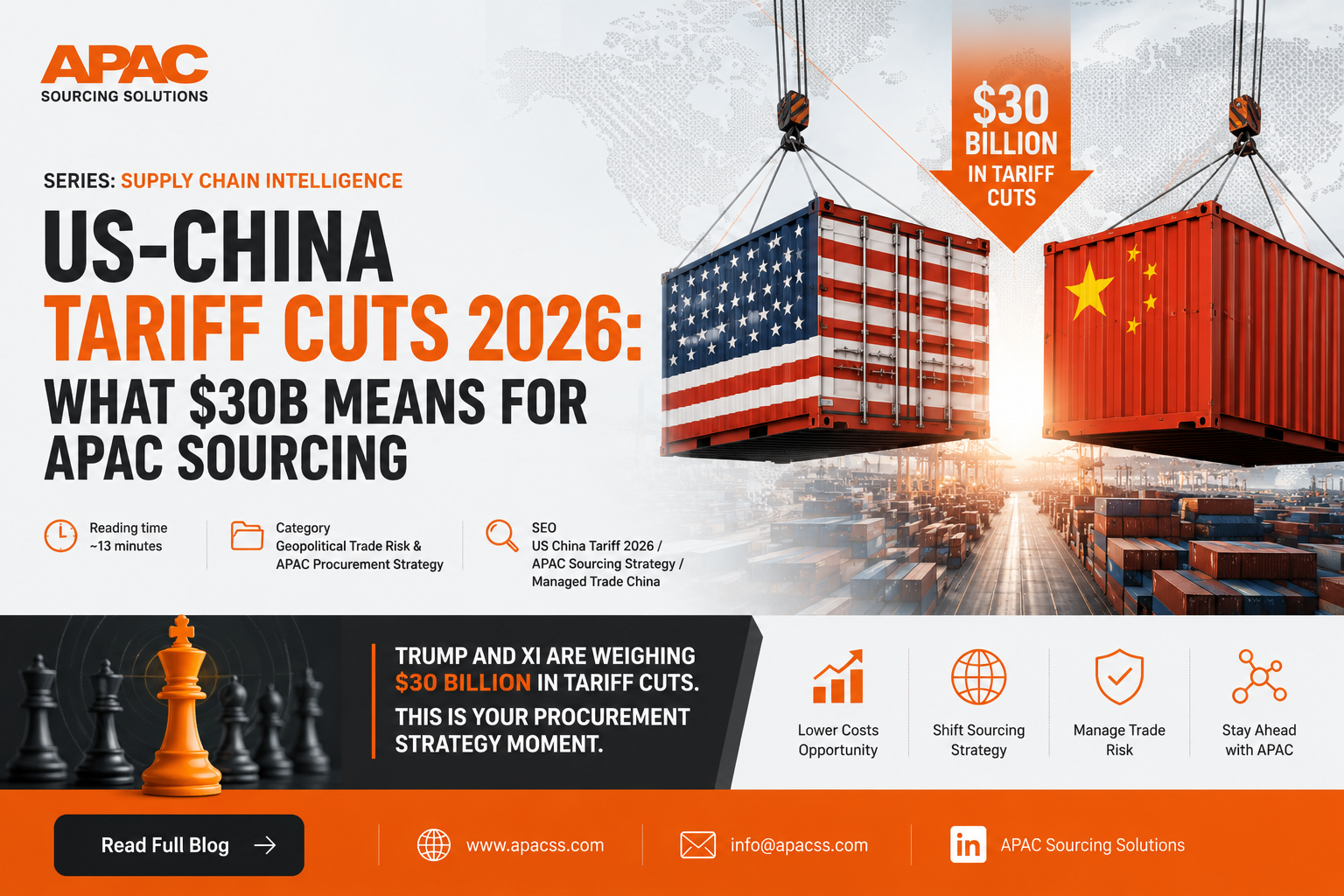
APAC Sourcing Solutions · Series: Supply Chain Intelligence · May 2026
Reading time: ~13 minutes · Category: Geopolitical Trade Risk & APAC Procurement Strategy · SEO: US China Tariff 2026 / APAC Sourcing Strategy / Managed Trade China
Trump and Xi Are Weighing $30 Billion in Tariff Cuts. This Is Your Procurement Strategy Moment.
Summary: A Reuters-reported managed trade framework between the US and China — targeting $30 billion worth of non-sensitive goods on each side — is being discussed at the Trump-Xi summit in Beijing this week. For APAC procurement and sourcing teams, this is not a geopolitical headline to file and forget. It is a direct input into supplier contract strategy, cost modelling, China+1 supply chain decisions, and sourcing geography allocation for 2026–2027. This intelligence briefing explains the mechanics of the framework, maps the implications across APAC's key sourcing geographies, and delivers a precise action plan for procurement leaders who need to respond intelligently — neither overreacting nor ignoring what is one of the most significant trade signals of the decade.
The Five Numbers That Define This Trade Moment
$30B
Each side's proposed tariff reduction basket
$415B
US-China two-way goods trade in 2025
–29%
Shrinkage in US-China trade 2024–2025
$50B
Upper range of goods basket under discussion
2,200+
Product exclusions from Trump's first term that could be revived
When Reuters reported on 13 May 2026 that the United States and China are expected to move toward a managed trade mechanism for non-sensitive goods — with each side potentially identifying $30 billion worth of products on which tariffs could be reduced — most observers read it as a diplomatic development. Procurement professionals should read it as a supply chain strategy input, and a time-sensitive one.
US-China goods trade has contracted by 29% from $582 billion to $415 billion over the past year. The tariff architecture that drove that contraction has also driven $1 trillion or more in supply chain reconfiguration investment across Asia-Pacific — in Vietnam, India, Indonesia, Malaysia, and a dozen other geographies that absorbed manufacturing capacity displaced from China. A managed trade reset, even a partial one on a $30 billion basket of non-sensitive goods, creates real questions that every APAC sourcing team needs to answer: Which of my sourced categories could be in scope? Does this change my China+1 strategy? What does the signal mean for my current supplier negotiations — regardless of whether my categories are named?
At APAC Sourcing Solutions, we operate across 15 APAC markets, 56 industry categories, and 18 product categories. Our 3,000+ validated supplier network spans China, India, South Korea, Taiwan, and Southeast Asia. What we are tracking this week is not just a trade headline — it is a structural signal with specific, addressable implications for procurement strategy. This briefing explains exactly what those implications are.
The question for sourcing leaders is not whether to react. It is how to react intelligently — capturing the strategic opportunity this signal creates without restructuring supplier agreements on the basis of a framework whose product categories have not yet been defined.
Table of Contents
- The Mechanics: What the Board of Trade Framework Actually Is
- What $30 Billion Means in Context: The Scale of US-China Trade Collapse
- The Sourcing Geography Impact: Which APAC Markets Face the Most Change
- The China+1 Question: Does This Signal a Reversal?
- The Procurement Opportunity Hidden in the Announcement
- Market-by-Market: What Each APAC Sourcing Region Means Right Now
- Your Action Plan: 4 Moves to Make Before This Signal Is Priced In
- How APAC Sourcing Solutions Navigates This For You
- Frequently Asked Questions (FAQ)
- Conclusion
1. The Mechanics: What the Board of Trade Framework Actually Is
The "Board of Trade" mechanism was first proposed by US Trade Representative Jamieson Greer in March 2026 as a key deliverable for the Trump-Xi summit in Beijing. Its structure is straightforward in principle: both the US and China identify a basket of non-sensitive, non-strategic goods — estimated at $30 to $50 billion per side — on which tariffs could be reduced without crossing national security red lines. The result is a managed bilateral trading arrangement in defined categories, not a broad tariff reduction or a return to pre-trade-war normalcy.
This is a structurally significant departure from past US-China trade frameworks. Washington is no longer demanding that Beijing restructure its state-directed, export-driven economic model to resemble the US consumer-driven model — the demand that made previous negotiating rounds collapse. Instead, the framework accepts the structural differences between the two economies and focuses on engineering numerical trading outcomes in specific, mutually acceptable categories.
What "Non-Sensitive" Means for Procurement
The critical variable for procurement teams is the definition of "non-sensitive." The framework explicitly keeps in place broad tariffs and export controls on national security-sensitive technologies — semiconductors, AI hardware, advanced materials, and defence-adjacent categories are not in scope. What is potentially in scope is a wide range of manufactured goods, industrial inputs, and consumer products that both sides produce and trade without strategic security concerns.
- Likely in scope: Industrial chemicals and intermediates, consumer goods, agricultural products, standard mechanical components, textiles, furniture, and non-advanced electronics where neither side has designated the category as strategically sensitive.
- Likely out of scope: Semiconductors, advanced electronics, battery technology, critical minerals, telecommunications equipment, pharmaceutical APIs under national security review, and any category covered by current US BIS export controls or entity list designations.
- Uncertain: The 2,200+ product exclusions granted during Trump's first term that have since expired — these are candidates for reinstatement and represent a significant potential expansion of the effective tariff relief beyond the headline $30 billion figure.
Procurement insight: The framework's product categories have not been officially defined as of the summit date. Procurement teams should monitor the official category list — expected to emerge in post-summit documentation — before restructuring supplier agreements. The signal, however, is clear enough to act on in supplier negotiations now.
2. What $30 Billion Means in Context: The Scale of US-China Trade Collapse
To understand why $30 billion matters — and why it is simultaneously significant and limited — procurement teams need the context of what has happened to US-China goods trade over the past year. US-China two-way goods trade shrank by 29% from $582 billion to $415 billion in 2025, with the US trade deficit falling nearly 32% to $202 billion — its lowest level in two decades. This contraction is one of the largest voluntary trade redirections in modern economic history, driven primarily by the Section 301 tariff architecture.
Against a $415 billion trade base, a $30 to $50 billion managed trade basket represents 7–12% of total bilateral trade volume. It is meaningful enough to move pricing and availability in specific categories — particularly for the non-sensitive manufactured goods most likely to be included — but it is not a reset of the overall trade relationship. The tariff architecture on the remaining 88–93% of US-China goods trade remains unchanged by this framework.
The Transmission from Trade Signal to Sourcing Decision
The mechanism through which this trade signal reaches procurement decisions works in three steps:
- Step 1 — Category identification: Once the product categories in the tariff reduction basket are defined, buyers sourcing those categories from alternative APAC geographies (Vietnam, India, Thailand) face a potential cost competitiveness shift back toward China-origin supply. The magnitude depends on the tariff rate reduction and the existing price differential with alternative sources.
- Step 2 — Supplier negotiation dynamics shift: Even before categories are defined, the announcement creates negotiating leverage for buyers across all APAC geographies. Suppliers in Vietnam, India, and Indonesia who built volume on the back of China diversification incentives now face the prospect — however uncertain — of Chinese competition returning. Buyers who use this moment to open contract renegotiations may extract meaningful concessions on price, payment terms, and volume flexibility.
- Step 3 — Supply chain architecture review: For categories specifically named in the final framework, a structured review of the cost differential between current alternative-source supply and potential China-origin supply under reduced tariffs is warranted. This review should be category-specific and data-driven — not a reflexive reversal of diversification strategy built over multiple years.
3. The Sourcing Geography Impact: Which APAC Markets Face the Most Change
Not all APAC sourcing geographies are equally exposed to a US-China tariff reset. The markets most directly affected are those that captured the largest share of supply chain investment displaced from China by Section 301 tariffs — and which would face the most direct competitive pressure if China-origin supply becomes price-competitive again in specific categories.
High Exposure: Vietnam, Mexico Analogue in APAC
Vietnam is the APAC market most directly exposed to a US-China tariff reset in manufacturing categories. Vietnam's manufacturing export growth over 2018–2025 was substantially driven by US buyer diversification away from Chinese supply in electronics assembly, furniture, footwear, textiles, and light manufacturing. If US-China tariff reductions specifically cover electronics assembly or consumer goods categories, Vietnam-origin supply in those categories faces restored Chinese competition for the same US buyers.
Moderate Exposure: India in Consumer and Industrial Categories
India's exposure is more category-specific and partially offset by its distinct structural advantages. India's chemical, pharmaceutical API, and agrochemical exports to the US are not primarily competitive with China-origin supply in those categories — India and China compete on quality differentiation and regulatory compliance as much as on price. For Indian industrial goods and consumer product categories that do compete directly with Chinese supply on price, exposure is moderate and manageable with strategic contract positioning.
Lower Exposure: Indonesia, Malaysia, South Korea
Indonesia's dominant oleochemical and palm-derivative supply base has no meaningful Chinese competition — China does not produce palm-origin chemistry at scale, and the managed trade framework does not change that structural reality. Malaysia's electronics supply chain serves a different quality tier than the consumer electronics categories most likely to be included in any tariff basket. South Korea's specialty chemical and high-value manufacturing exports compete on quality and regulatory standards rather than price — categories where Chinese competition under reduced tariffs does not fundamentally alter the value proposition.
Procurement insight: The exposure analysis should be done at the category level, not the geography level. A buyer sourcing pharmaceutical APIs from India and consumer electronics from Vietnam faces two entirely different risk profiles from the same trade framework announcement. Category-level analysis is the foundation of an intelligent response.
4. The China+1 Question: Does This Signal a Reversal?
The question procurement leaders are asking this week is whether the managed trade framework signals a reversal of China+1 strategy — and whether the supply chain diversification investments made over 2018–2025 need to be reassessed. The honest answer is: not yet, and probably not fundamentally.
Why China+1 Strategy Remains Valid
- Broad tariffs remain in place: The managed trade framework explicitly preserves the existing tariff architecture on the vast majority of US-China goods trade. It creates a managed exception for non-sensitive categories — it does not roll back the Section 301 structure that drove diversification in the first place.
- National security controls are untouched: Export controls on semiconductors, advanced technology, and defence-adjacent supply chains are specifically excluded from the framework. For buyers in these categories, nothing changes.
- Geopolitical risk concentration argument is unchanged: Supply chain concentration in China carries geopolitical risk that is independent of tariff levels — the risk of sudden escalation, export controls, or political disruption remains. Diversification built to manage concentration risk remains justified regardless of tariff adjustments.
- Category-specific, not market-wide: The framework applies to a defined basket of non-sensitive goods, not to Chinese manufacturing capacity broadly. The structural advantages that Vietnam, India, and Indonesia have built in manufacturing cost, regulatory compliance, and supply chain maturity do not disappear because China-origin supply becomes slightly cheaper in a subset of categories.
Where a Category-Level Review Is Warranted
For buyers whose sourced categories are likely to be included in the non-sensitive basket — consumer goods, standard industrial inputs, agricultural products, non-strategic chemicals — a structured cost comparison between current alternative-source supply and potential China-origin supply under reduced tariffs is prudent. This is a review exercise, not a restructuring trigger. The review should be completed with actual product category definitions in hand, not on the basis of the headline framework announcement alone.
5. The Procurement Opportunity Hidden in the Announcement
The most underappreciated element of the managed trade announcement for procurement teams is not the potential cost change in specific categories — it is the negotiating leverage the announcement creates across all APAC supplier relationships, right now, regardless of which categories are ultimately named.
The Leverage Window: Why Suppliers Are Listening Differently This Week
Suppliers in Vietnam, India, Indonesia, and Thailand built volume — and in some cases, entire business models — on the assumption that Chinese competition in their categories was structurally excluded by the US tariff architecture. This week's announcement challenges that assumption, even if the actual product categories named ultimately do not include their specific goods. The uncertainty itself creates willingness to negotiate that did not exist a month ago.
- Pricing concessions: Suppliers uncertain about their competitive position relative to China-origin alternatives in their categories are more receptive to pricing discussions than they would be in a supply-constrained environment. Buyers who open renegotiation conversations now — citing the trade framework signal — are operating from a position of unusual leverage.
- Volume flexibility: Minimum order quantity requirements, volume commitments, and contract flexibility terms that were non-negotiable during the peak diversification period (2021–2024) are more open to discussion in an environment where suppliers face uncertainty about their competitive position.
- Multi-year contract terms: Paradoxically, suppliers who want to lock in volume commitment from buyers — before the category outcome is known — may be willing to offer multi-year pricing that protects buyers against future cost increases. The uncertainty benefits buyers who move quickly on long-term contracting conversations.
Procurement insight: Trade announcements create negotiating environments. The time to use this one is before the product category list is published — when uncertainty is highest and supplier willingness to negotiate is greatest. Buyers who wait for category certainty will find the leverage window has closed.
6. Market-by-Market: What Each APAC Sourcing Region Means Right Now
APAC Sourcing Solutions operates across 15 APAC markets. Below is a rapid-read briefing on how each major sourcing region is positioned in the current managed trade environment — and what it means for procurement teams building their 2026 H2 and 2027 sourcing strategy.
China — REASSESS: Managed Opportunity, Not Blanket Return
China is not back as a blanket sourcing default — but for specific non-sensitive categories that appear in the tariff reduction basket, a cost comparison with current alternative-source supply is warranted. For non-US buyers who were never subject to Section 301 tariffs, redirected Chinese supply in organic chemicals, standard industrial inputs, and consumer goods has been available at competitive pricing throughout the trade war period. The managed trade framework may expand China's commercial accessibility for US-market buyers in defined categories without changing the strategic calculus for technology, security-adjacent, or heavily regulated categories.
India — ACCELERATE: Structural Advantages Are Unaffected
India's position as the dominant global source of pharmaceutical APIs, agrochemicals, dyes, and specialty chemicals is not challenged by a US-China managed trade framework that targets non-sensitive consumer and industrial goods. India's GMP-certified API manufacturers, specialty chemical producers, and agrochemical exporters compete on regulatory compliance and quality as much as price — categories where Chinese competition under reduced tariffs does not fundamentally alter the competitive landscape. Additionally, INR depreciation continues to compress USD-denominated export pricing from India, maintaining a near-term pricing advantage for USD buyers independent of the US-China trade dynamic.
Vietnam — MONITOR: Category Risk Highest Here
Vietnam faces the most direct category exposure risk of any APAC sourcing geography. Electronics assembly, furniture, textiles, and footwear — Vietnam's core export categories to the US — are precisely the type of non-sensitive manufactured goods most likely to appear in a tariff reduction basket. Procurement teams sourcing these categories from Vietnam should begin a cost comparison exercise now, before official categories are named, and open contract flexibility conversations with Vietnamese suppliers who have the strongest incentive to negotiate before the competitive picture becomes clearer.
Indonesia — EXPAND: Oleochemicals and Sustainable Chemistry Unaffected
Indonesia's palm-derivative oleochemical supply base has no meaningful Chinese competition and faces no competitive pressure from any US-China tariff framework. For buyers of fatty acids, glycerine, stearic acid, and RSPO-certified sustainable chemical inputs, Indonesia's position as the world's dominant supply source is unchanged. Indonesian oleochemical producers are actively seeking volume commitments from international buyers, and the current environment — where the broader trade uncertainty creates procurement team attention — is a natural moment to advance those conversations.
South Korea and Taiwan — EXPAND: Quality Tier Insulated from Price Competition
South Korea's specialty chemicals, engineering resins, and pharmaceutical excipients, and Taiwan's electronics-grade chemistry and high-performance coating materials, compete in quality tiers where Chinese supply under reduced tariffs does not represent equivalent substitution. For buyers in regulated markets, advanced manufacturing, or semiconductor supply chains, the qualification bar for Chinese supply is not reduced by tariff adjustments alone. South Korean and Taiwanese suppliers remain the logical backup qualification targets for buyers managing India supply concentration risk.
Malaysia and Thailand — BUILD: Structural Investment Thesis Intact
Malaysia's electronics cluster and Thailand's petrochemical complex are building toward greater self-sufficiency and export capacity across categories where they have natural feedstock or manufacturing infrastructure advantages. The managed trade framework does not alter the 3–5 year supply chain development trajectory for either market. Buyers who are building strategic supply relationships in these geographies as medium-term alternatives should continue that process — the investment thesis remains sound regardless of near-term US-China trade adjustments.
7. Your Action Plan: 4 Moves to Make Before This Signal Is Priced In
The managed trade announcement creates a specific, time-limited window for procurement teams to act intelligently. Here are the four concrete moves that should be on every APAC sourcing leader's desk this week:
Move 1: Map Your Category Exposure to the Non-Sensitive Goods Basket
Start with a category-level audit: which of your currently sourced categories are likely to fall within the definition of non-sensitive, non-strategic goods? Consumer products, standard industrial inputs, agricultural goods, and non-advanced electronics are the most probable inclusions. This mapping exercise takes 2–4 hours with the data you already have and creates the foundation for every subsequent decision. Categories with high China-origin competitiveness on price, currently sourced from alternative APAC geographies under Section 301 displacement logic, should be flagged for immediate cost comparison modelling.
Move 2: Open Renegotiation Conversations with Current APAC Suppliers Now
Contact your top suppliers in Vietnam, India, and other APAC alternative-source geographies and open contract flexibility conversations — citing the trade framework development as the context. The goal is not to threaten supplier relationships built over years; it is to use an exceptional moment of supplier negotiating uncertainty to extract concessions on pricing, minimum order quantities, volume flexibility, and contract term length that would not be available in a more stable trade environment. The window for this leverage is measured in weeks, not months — it closes when the official category list is published and the competitive picture becomes clear.
Move 3: Build a Three-Scenario Cost Model for Each At-Risk Category
A resilient sourcing strategy in the current environment accounts for three outcomes, all of which remain plausible: (1) tariffs stay — the managed trade framework is announced but implementation stalls, product categories are not defined, and the current supply chain architecture remains optimal; (2) tariffs cut — specific categories are named, China-origin supply becomes price-competitive, and a category-level review of supplier allocation is warranted; and (3) tariffs escalate — the summit produces no durable agreement, tensions re-escalate, and the diversification rationale strengthens further. Modelling all three for your highest-spend categories creates decision clarity regardless of the outcome.
Move 4: Engage APAC Sourcing Solutions for Category Intelligence and Supplier Access Across All Scenarios
All three scenarios above require category-level market intelligence, supplier network access, and negotiation support across multiple APAC geographies simultaneously. APAC Sourcing Solutions operates with 3,000+ validated suppliers across China, India, South Korea, Taiwan, Indonesia, and the broader APAC region — with direct market presence in every geography relevant to the managed trade framework's implications. Whether you need to model China-origin cost competitiveness in specific categories, renegotiate existing APAC supplier contracts from a position of market intelligence, or qualify new sources as part of a three-scenario resilience strategy — the fastest path to executing this action plan is to start a conversation with our sourcing team this week.
Contact our sourcing team at info@apacss.com with your sourced category, current supply geography, annual volume, and key concern — and we will provide a specific, intelligence-backed response within 48 hours on category exposure, supplier options, and negotiation positioning for your situation.
8. How APAC Sourcing Solutions Navigates This For You
APAC Sourcing Solutions operates as Asia's B2B sourcing bridge — 15 years of regional supplier relationships, 3,000+ validated suppliers across 15 APAC markets, coverage across 56 industry categories and 18 product categories, and four specialised service lines that address every dimension of the current managed trade environment.
Here is how our service infrastructure directly addresses each element of the US-China tariff signal and its APAC supply chain implications:
- Strategic Sourcing (Supplier Discovery & Market Access): We identify and qualify the optimal supplier for your specific requirement across our 3,000+ supplier network spanning China, India, South Korea, Taiwan, and Southeast Asia — specification, grade, volume, certification, and market compliance. In the current environment, we are executing active multi-geography cost comparison projects and supplier renegotiation support engagements for buyers who recognise the intelligence value of understanding all-in landed costs across competing supply geographies simultaneously.
- Global Trading (Factory-to-Door Logistics, LCL / FCL): We handle factory-to-door delivery across APAC, managing LCL and FCL logistics, customs documentation, and import compliance for 50+ destination countries. Our 3,500+ shipping order track record and 65,000 MT+ delivered volume means we have active carrier relationships across every APAC export corridor — including the ability to model landed cost comparisons across China, India, and Southeast Asian supply origins for the same destination market.
- CRAMs (Contract Manufacturing & R&D Manufacturing): For buyers who need custom synthesis, pharmaceutical intermediates, or R&D-scale manufacturing from Asia — our CRAM network in India and South Korea provides GMP-qualified contract manufacturing capacity that is not competitively affected by US-China tariff adjustments in non-sensitive goods. Regulated-market manufacturing quality requirements insulate CRAM categories from commodity tariff competition.
- India Chemical Distribution (Import & Distribution, Specialty & Life Sciences): For international chemical manufacturers seeking India market access — one of Asia's fastest-growing chemical end-markets — we provide compliant, documented distribution and import management that navigates India's complex chemical import regulations, GST compliance requirements, and state-specific logistics. India's domestic market growth trajectory is unaffected by US-China managed trade dynamics.
Whether you need to model China-origin cost competitiveness against your current APAC supply base, renegotiate supplier contracts from a position of market intelligence, qualify new sources across any APAC geography, or simply understand which of your categories face the most exposure from the managed trade framework — we welcome the conversation. Contact us at info@apacss.com or visit www.apacss.com.
9. Frequently Asked Questions (FAQ)
What is the US-China managed trade framework announced in May 2026?
The managed trade framework — referred to as the "Board of Trade" — is a mechanism proposed by US Trade Representative Jamieson Greer in March 2026. It involves both the US and China identifying approximately $30 to $50 billion worth of non-sensitive goods each on which they could reduce tariffs and trade with each other without crossing national security red lines. Product categories have not been officially defined as of the summit date. The framework explicitly preserves broad tariffs and export controls on strategic, security-sensitive, and technology categories — it is a managed exception in defined goods, not a reset of the overall trade relationship.
How do US-China tariff cuts affect APAC supply chains and sourcing strategy?
US-China tariff cuts on non-sensitive goods could make China-origin products more price-competitive again for US buyers in specific named categories — potentially creating competitive pressure on Vietnam, India, and other APAC alternative-source geographies in those same categories. However, the framework is category-specific and limited in scope relative to total US-China trade. For APAC sourcing teams, the most immediate value of the announcement is the negotiating leverage it creates across all supplier relationships, regardless of which categories are ultimately named. A category-level cost modelling exercise and a supplier renegotiation conversation are the two most valuable responses available right now.
Should companies reverse their China+1 sourcing strategy in light of tariff cut discussions?
No. China+1 strategies built to manage supply chain concentration risk, geopolitical exposure, and compliance requirements remain valid. The managed trade framework targets non-sensitive goods in non-strategic sectors and explicitly preserves the broad tariff and export control architecture. Geopolitical concentration risk in China is independent of tariff levels. For categories specifically named in the final tariff reduction basket, a structured cost comparison is warranted — but this is a review exercise, not a reversal trigger. Buyers who rebuilt supply chains over multiple years should not dismantle that architecture on the basis of an announcement whose product categories are not yet defined.
Which APAC sourcing geographies are most affected by US-China tariff cuts?
Vietnam faces the highest category exposure risk — electronics assembly, furniture, textiles, and footwear are the non-sensitive manufacturing categories most likely to appear in a tariff reduction basket, and these are Vietnam's core US export categories. India faces moderate and category-specific exposure, with pharmaceutical APIs, specialty chemicals, and agrochemicals largely insulated by quality and regulatory differentiation from Chinese competition. Indonesia, South Korea, Taiwan, and Malaysia face lower exposure due to structural supply advantages — oleochemicals, quality-tier chemistry, and electronics-grade materials — where Chinese competition under reduced tariffs does not represent equivalent substitution.
How should procurement teams respond to the US-China tariff cut announcement?
Procurement teams should take four immediate actions: (1) map which of their sourced categories fall into non-sensitive, non-strategic goods most likely to appear in the tariff reduction basket; (2) open renegotiation conversations with current APAC suppliers now, using the trade uncertainty as leverage before the competitive picture becomes clear; (3) build a three-scenario cost model — tariffs stay, tariffs cut, tariffs escalate — for each at-risk category; and (4) engage a sourcing partner with pre-qualified supplier networks across all relevant APAC geographies to execute category intelligence, cost comparison, and supplier negotiation support simultaneously. Speed of intelligence is the operative advantage — the window for maximum leverage closes when official category lists are published.
10. Conclusion
Trump and Xi did not convene in Beijing to create a procurement intelligence briefing. But the managed trade framework they are discussing — a $30 to $50 billion basket of non-sensitive goods, a Board of Trade mechanism, and the first structural departure from Washington's demand that China change its economic model — tells a supply chain story that every B2B procurement team sourcing across Asia-Pacific needs to read correctly.
The story is not simply one of risk to existing APAC supply chains. It is a story of strategic leverage — of procurement environments where uncertainty creates negotiating opportunity, where the window to extract concessions from suppliers whose competitive confidence has just been shaken is measured in weeks, and where the buyers who act with market intelligence and appropriate speed will outperform competitors who wait for certainty that arrives too late to be useful. Vietnam suppliers who built volume on Section 301 displacement logic are negotiating differently this week than they were last month. India exporters whose INR-advantaged pricing already offers a compelling window are offering contract terms they will not offer in 12 months. Chinese manufacturers in non-sensitive categories are accessible at competitive pricing for buyers whose supply chain architecture allows it.
At APAC Sourcing Solutions, we cover 15 APAC markets, 56 industry categories, and 18 product categories — with 3,000+ validated suppliers, 65,000 MT+ of volume delivered, 3,500+ B2B shipping orders processed, and 15 years of regional market relationships built precisely for moments like this one. We are Asia's B2B sourcing bridge. And in May 2026, that bridge connects buyers not just to supply — but to strategic advantage in one of the most dynamic trade environments of the decade.
If you are reviewing your APAC sourcing strategy in light of the US-China managed trade framework, reassessing your China+1 supply chain architecture, or looking to use this moment of supplier uncertainty to improve your contract terms across any APAC geography — we welcome the conversation. The leverage window is open now. Contact us at info@apacss.com or visit www.apacss.com.


