


Sorbitol: Complete Sourcing, Grades & Applications Guide | APAC Supply Chain
APAC Supply Chain | CDMO · Series: Everyday Products × Hidden Ingredients · March 2026
Reading time: ~8 minutes · Category: Ingredients & Raw Materials · SEO: Sorbitol / Sorbitol Supplier India
Sorbitol: The Versatile Sugar Alcohol Powering Pharmaceuticals, Food, and Personal Care — Complete Sourcing Guide
Meta Description: Sorbitol is one of the most widely used polyols in pharmaceutical excipients, food manufacturing, and personal care formulation. Discover its chemistry, grades, applications, global supply chain dynamics, and why procurement teams across Asia trust APAC Supply Chain for bulk Sorbitol sourcing.
Every time you take a liquid cough syrup, bite into a sugar-free chocolate, squeeze toothpaste onto your brush, or apply a moisturising lotion — there's a very strong chance that sorbitol is doing the quiet, essential work behind the scenes.
Sorbitol — also called D-glucitol — is a naturally occurring sugar alcohol (polyol) that has become one of the most commercially important excipients and functional ingredients in the world. It serves simultaneously as a humectant, sweetener, texturiser, plasticiser, and stabiliser across pharmaceuticals, food & beverage, oral care, and cosmetics manufacturing.
In this complete sourcing guide, we break down everything procurement managers, R&D formulators, and supply chain professionals need to know about Sorbitol: its chemistry, commercial grades, key applications, global market dynamics, and how to source it reliably at scale.
Table of Contents
- What Is Sorbitol?
- Chemical Properties & Commercial Grades
- How Sorbitol Works: Key Functional Mechanisms
- Industrial & Commercial Applications
- How Sorbitol Is Manufactured
- Global Market & Supply Chain Overview
- How to Source Sorbitol: What Buyers Need to Know
- Why APAC Supply Chain & CDMO for Sorbitol Procurement
- Frequently Asked Questions (FAQ)
- Conclusion
1. What Is Sorbitol?
Sorbitol is a hexahydric sugar alcohol derived from glucose through a process called catalytic hydrogenation. It belongs to the polyol family — alongside mannitol, xylitol, and maltitol — and occurs naturally in small quantities in fruits such as apples, pears, plums, and cherries.
Commercially, Sorbitol is produced at industrial scale from corn starch-derived glucose syrup, making it cost-effective, highly scalable, and widely available. It is typically sold as a clear, colourless aqueous solution (70% concentration) or as a white crystalline powder, depending on the intended application.
What makes Sorbitol so commercially indispensable is its extraordinary multi-functionality: it provides sweetness without spiking blood sugar, retains moisture in formulations, acts as a plasticiser in capsule shells, serves as a bulking agent in tablets, and provides a cooling mouthfeel in oral care products — all in one ingredient.
Key fact: Sorbitol is listed as a GRAS (Generally Recognized As Safe) substance by the US FDA and is approved under the EU Food Additives Regulation as E420. It holds monograph status in USP, BP, EP, and JP — making it one of the most universally accepted excipients in global pharmaceutical manufacturing.
2. Chemical Properties & Commercial Grades
Basic Chemistry
- IUPAC Name: (2R,3R,4R,5S)-Hexane-1,2,3,4,5,6-hexol
- Also Known As: D-Glucitol, D-Sorbitol
- CAS Number: 50-70-4
- Molecular Formula: C₆H₁₄O₆
- Molecular Weight: 182.17 g/mol
- Appearance: White crystalline powder (solid) or clear, colourless viscous liquid (70% solution)
- Odour: Odourless
- Taste: Sweet, cooling — approximately 60% the sweetness of sucrose
- Solubility: Freely soluble in water; slightly soluble in ethanol
- Melting Point: 95–97°C (crystalline form)
- Hygroscopicity: Highly hygroscopic — requires controlled storage conditions
- Caloric Value: ~2.6 kcal/g (versus 4 kcal/g for sucrose)
- Glycaemic Index: 9 (extremely low — diabetic-safe)
Commercial Grades
- Pharmaceutical Grade (USP / BP / EP / JP): Highest purity (>99% assay), full pharmacopoeial compliance, batch CoA, heavy metal testing, microbial limits. Required for oral liquid formulations, injectable excipients, and capsule shell plasticisation.
- Food Grade (FCC / E420): Compliant with Food Chemicals Codex and EU E420 designation. Used in confectionery, baked goods, sugar-free products, and beverages. Must meet specific colour, odour, and purity standards.
- Cosmetic / Personal Care Grade: Suitable for topical applications — moisturisers, shampoos, lotions, and oral care products. Requires low microbial counts and absence of skin sensitisers.
- Industrial / Technical Grade: Lower purity threshold acceptable for surfactant synthesis, resin production, and vitamin C (ascorbic acid) manufacturing. Cost-optimised for large-volume chemical synthesis.
- Sorbitol Solution 70% (Non-Crystallising): The most commercially traded liquid form. Contains a defined ratio of sorbitol to other polyols (mannitol, maltitol) that prevents crystallisation during storage — critical for liquid pharmaceutical and food applications.
- Crystalline Sorbitol Powder: Preferred for direct compression tablet manufacturing, hard candy production, and applications requiring precise dosage control.
Procurement tip: Always specify whether you require crystallising or non-crystallising sorbitol solution. Non-crystallising grades contain small amounts of mannitol and other polyols that inhibit crystal formation — critical for stable liquid formulations, especially in cold-chain environments. Mixing up these grades at procurement stage is one of the most common and costly formulation errors.
3. How Sorbitol Works: Key Functional Mechanisms
Sorbitol's extraordinary versatility across industries stems from several distinct physicochemical properties that activate different functions depending on the application context:
Humectancy & Moisture Retention
Sorbitol's six hydroxyl (-OH) groups form hydrogen bonds with water molecules, allowing it to attract and retain moisture from the environment. This makes it a powerful humectant in cosmetics, toothpaste, and pharmaceutical liquids — preventing drying, cracking, and product instability over time.
Plasticisation of Gelatin Capsules
In softgel and hard capsule manufacturing, sorbitol acts as a plasticiser alongside glycerol — imparting flexibility to the capsule shell, preventing brittleness, and maintaining capsule integrity during filling, packaging, and storage. It is one of only a handful of ingredients globally approved for this critical pharmaceutical function.
Low-Glycaemic Sweetening
Sorbitol is absorbed slowly and incompletely in the small intestine, resulting in a minimal insulin response. This makes it the sweetener of choice for diabetic-friendly foods, sugar-free confectionery, and pharmaceutical syrups intended for diabetic patients. Its glycaemic index of just 9 (versus 65 for sucrose) is a critical differentiator.
Osmotic Laxative Effect (Pharmaceutical Use)
At therapeutic doses (typically 25–150g), sorbitol acts as an osmotic laxative by drawing water into the large intestine, stimulating bowel movement. It is used in clinical settings as a cathartic agent and in rectal enema preparations — a distinct pharmaceutical application from its excipient uses.
Cryoprotection
Sorbitol is used as a cryoprotectant in biological products, vaccines, and freeze-dried (lyophilised) pharmaceutical formulations. Its ability to form a glassy matrix during freezing protects protein structures and extends product stability — a function critical in biologics and biosimilar manufacturing.
4. Industrial & Commercial Applications
Pharmaceutical Manufacturing
Sorbitol is one of the most versatile pharmaceutical excipients in the industry. Its key pharmaceutical applications include:
- Oral liquid formulations: Syrups, suspensions, and elixirs — used as a sweetener, viscosity modifier, and co-solvent
- Tablet manufacturing: Direct compression filler and binder in chewable tablets; also used as a diluent in effervescent formulations
- Softgel capsules: Plasticiser in the gelatin shell alongside glycerol
- Osmotic laxative preparations: Active ingredient in rectal enemas and bowel-cleansing solutions
- Lyophilised biologics & vaccines: Cryoprotectant and bulking agent in freeze-dried formulations
- Topical & ophthalmic preparations: Humectant and tonicity agent in eye drops and creams
Food & Beverage Industry
Sorbitol (E420) is authorised across all major food regulatory frameworks. Applications include:
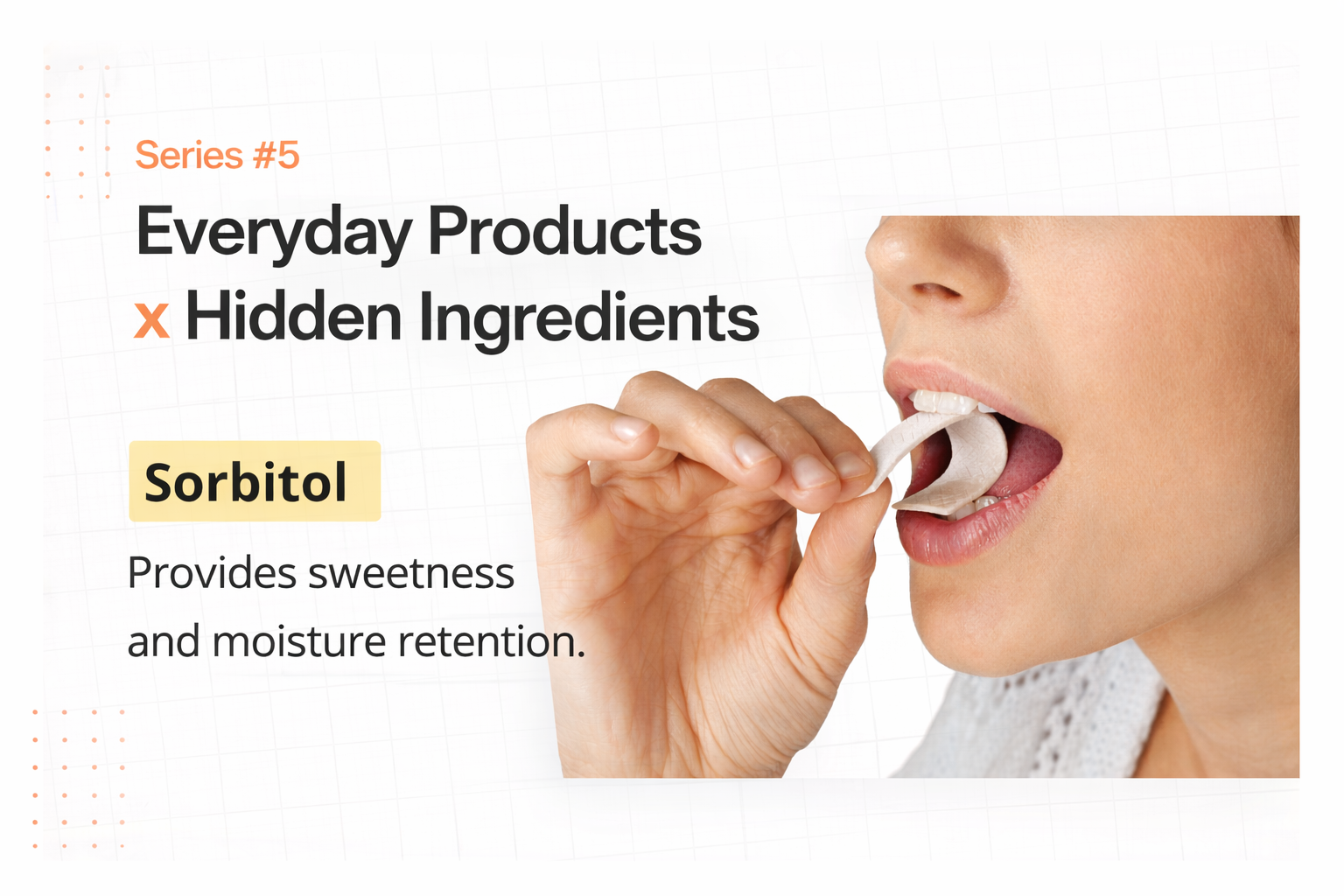
- Sugar-free confectionery: Chewing gum, hard candies, and chocolate — provides sweetness and texture without sugar's caloric density
- Baked goods: Moisture retention prevents staling; extends shelf life in soft breads and cakes
- Diabetic food products: Low-glycaemic sweetener in jams, spreads, and functional foods
- Beverages: Humectant and flavour carrier in fruit drinks and functional beverages
- Dairy products: Texture enhancer and cryoprotectant in ice cream and frozen yogurt
Personal Care & Cosmetics
- Toothpaste & mouthwash: Primary humectant — prevents drying, adds mild sweetness, and provides smooth texture. Present in virtually every major toothpaste brand at 20–30% by weight
- Skin care: Moisturiser and humectant in creams, lotions, serums, and cleansers
- Hair care: Conditioning agent in shampoos and conditioners; prevents moisture loss
- Cosmetic creams: Improves spreadability and skin feel; stabilises emulsions
Chemical Industry
- Ascorbic Acid (Vitamin C) synthesis: Sorbitol is the primary feedstock for industrial Vitamin C production via the Reichstein process — this alone accounts for a major share of global sorbitol demand
- Surfactant synthesis: Sorbitol is esterified with fatty acids to produce Span and Tween series non-ionic surfactants (sorbitan esters) — widely used as emulsifiers in food, pharma, and cosmetics
- Alkyd resins & polyurethane: Sorbitol is used as a polyol building block in resin and polymer synthesis
- Industrial humectant: Used in printing inks, paper, leather processing, and tobacco
Did you know? Approximately 15–20% of global sorbitol production is consumed as a feedstock in Ascorbic Acid (Vitamin C) manufacturing. This creates a direct linkage between Sorbitol pricing and the global Vitamin C supply chain — a key consideration for pharma procurement teams managing multiple excipient categories simultaneously.
5. How Sorbitol Is Manufactured
Commercial sorbitol production follows a well-established catalytic process, and understanding it is relevant to buyers evaluating supply chain resilience, feedstock risk, and quality consistency.
Step 1 — Starch Hydrolysis
The process begins with corn starch (or wheat/tapioca starch in some regions), which is enzymatically hydrolysed using alpha-amylase and glucoamylase enzymes to produce a high-purity glucose syrup (dextrose equivalent >95%). The quality of this glucose feedstock directly impacts the purity and colour of the final sorbitol product.
Step 2 — Catalytic Hydrogenation
The glucose syrup is then subjected to high-pressure catalytic hydrogenation — typically using a Raney nickel or ruthenium catalyst at temperatures of 120–160°C and pressures of 40–70 bar. In this reaction, the aldehyde group of glucose is reduced to a hydroxyl group, converting glucose (C₆H₁₂O₆) to sorbitol (C₆H₁₄O₆).
Step 3 — Purification & Refinement
Post-hydrogenation, the crude sorbitol solution undergoes activated carbon treatment (decolourisation), ion exchange purification (demineralisation), and filtration to achieve pharmaceutical or food-grade purity levels. Residual nickel content is monitored carefully for pharmaceutical applications due to ICH Q3D elemental impurity guidelines.
Step 4 — Evaporation / Crystallisation
The purified solution is either concentrated by evaporation to the commercially standard 70% sorbitol solution, or further processed by controlled crystallisation and drying to produce crystalline sorbitol powder. The non-crystallising grade is formulated at this stage by blending in specific ratios of mannitol and other polyols.
Supply chain implication: Because sorbitol is corn-derived, its pricing is correlated with global corn and glucose syrup markets. Buyers in India and Southeast Asia should monitor CBOT corn futures and regional starch prices when planning annual sorbitol procurement contracts. Price volatility of 15–25% within a calendar year is not uncommon.
6. Global Market & Supply Chain Overview
Market Size & Growth
The global sorbitol market was valued at approximately USD 1.1–1.3 billion in 2024 and is projected to grow at a CAGR of 5.5–6.2% through 2030, driven by expanding demand across pharmaceutical excipients, sugar-free food products, and personal care formulation in emerging markets.
Asia-Pacific dominates both production and consumption — accounting for over 55% of global sorbitol output. India and China are the largest consuming markets in Asia, driven by their massive pharmaceutical generic manufacturing sectors, growing FMCG industries, and expanding middle-class demand for sugar-free and functional food products.
Key Global Producers
- Roquette Frères (France): The world's largest sorbitol producer; supplies pharmaceutical, food, and cosmetic grades globally. Produces under the NEOSORB® brand.
- Cargill (USA): Major food-grade and pharmaceutical-grade sorbitol producer with global distribution.
- ADM (Archer-Daniels-Midland, USA): Corn-based polyol manufacturer supplying food and industrial grades.
- SPI Pharma / DFE Pharma: Specialised pharmaceutical-grade sorbitol supplier for excipient applications.
- Gulshan Polyols Ltd (India): Leading domestic Indian sorbitol producer.
- PT Sorini Agro Asia Corporindo (Indonesia): Southeast Asia's largest sorbitol manufacturer; key supplier for the ASEAN region.
- Zhucheng Dongxiao (China): High-volume Chinese producer supplying industrial, food, and pharma grades to global buyers.
Regional Supply Chain Dynamics
- India: Major consuming market for pharmaceutical-grade sorbitol; domestic production is growing but high-specification pharma grades are still partially import-dependent. Key ports: JNPT (Mumbai), Mundra, Chennai.
- Southeast Asia: Indonesia is a major regional supplier; Thailand, Malaysia, and Vietnam are significant importers for food and personal care industries.
- Middle East & Africa: Import-dependent markets; sourcing primarily from India, Indonesia, and China via established trade routes. Growing pharma manufacturing in Egypt, Saudi Arabia, and UAE driving demand.
- Europe: Premium pharmaceutical-grade market dominated by Roquette and DFE Pharma; regulatory documentation requirements (CEP, EDMF) are mandatory for API excipient supply.
7. How to Source Sorbitol: What Buyers Need to Know
Define Your Grade Before You Quote
The most common sourcing mistake is quoting for "sorbitol" without specifying the grade. Pharmaceutical, food, cosmetic, and industrial grades differ significantly in purity specifications, testing requirements, documentation, and — critically — price. Always specify your intended application, pharmacopoeial standard (USP/BP/EP/JP/FCC), required concentration (solution or powder), and any application-specific requirements (e.g., residual nickel limits for parenteral use) before requesting quotes.
Key Documentation to Request from Suppliers
- Certificate of Analysis (CoA) — batch-specific, not generic
- Certificate of Origin (CoO)
- Safety Data Sheet (SDS / MSDS)
- Technical Data Sheet (TDS)
- Drug Master File (DMF) reference or CEP (for pharmaceutical applications)
- Heavy Metal / Elemental Impurity testing report (ICH Q3D compliance for pharma)
- Allergen & GMO declaration (food and pharma)
- Halal / Kosher certification (where required by market)
- Supplier audit or GMP compliance certificate
Packaging & Logistics Considerations
Sorbitol solution (70%) is typically supplied in 250 kg HDPE drums or 1,000 kg IBC totes for mid-volume buyers, and in flexitank or ISO tank containers for bulk industrial shipments. Crystalline sorbitol powder is packaged in 25 kg multi-layer paper bags or 500–1000 kg bulk bags (FIBCs). Given sorbitol's high hygroscopicity, storage in sealed, moisture-controlled environments is critical — exposure to humidity causes caking in powder grades and dilution inconsistencies in solution grades.
Pricing Benchmarks & MOQ Guidance
- Food Grade Sorbitol Solution 70%: USD 500–700/MT (China/India origin, FOB) — subject to corn market fluctuations
- Pharmaceutical Grade Sorbitol Solution 70% (USP/BP): USD 900–1,400/MT — premium for documentation and testing compliance
- Crystalline Sorbitol Powder (Food/Pharma): USD 1,100–1,800/MT — reflects additional processing cost
- MOQ: Typically 1 MT for samples/trials; 5–20 MT for standard commercial orders; 100 MT+ for annual contract pricing
Buyer alert: Always compare Sorbitol pricing on a dry weight / active content basis, not per MT of solution. A 70% solution and a 68% solution at the same price per MT represent materially different values. Request the actual sorbitol content percentage from each supplier and normalise accordingly during cost comparison.
8. Why APAC Supply Chain & CDMO for Sorbitol Procurement
At APAC Supply Chain | CDMO, we understand that sorbitol procurement is not a commodity transaction — it's a formulation-critical decision with direct implications for product quality, regulatory compliance, and manufacturing continuity.
Our sourcing team works with qualified, audited suppliers across India, Indonesia, and China to provide pharmaceutical, food, and cosmetic grade sorbitol with the documentation integrity that modern manufacturing demands. Here's what differentiates our approach:
- Grade-Specific Sourcing: We don't offer a one-grade-fits-all solution. We work with your formulation team to identify the exact specification — crystallising vs non-crystallising, USP vs EP vs FCC, solution vs powder — and source accordingly.
- Full Documentation Package: Every shipment includes batch CoA, CoO, SDS, TDS, and application-specific compliance certificates. For pharmaceutical customers, we support DMF referencing and CEP sourcing.
- Regulatory Coverage — HCR & LCR Markets: Whether you're formulating for US/EU/Japanese markets (High Cost Regions) or for India/SEA/MEA markets (Low Cost Regions), we know the regulatory requirements and source accordingly. One procurement partner for every market.
- ISO 9001:2015 & EcoVadis Committed: Our quality management system and sustainability accountability are third-party validated — giving your quality and compliance teams the confidence to on-board us rapidly.
- Competitive Pricing with Transparent Costing: We provide pricing on a normalised active-content basis, with transparent logistics and documentation cost breakdowns — no hidden charges.
- Rapid Qualification Support: Need to qualify a new sorbitol supplier or replace an existing one urgently? Our team can mobilise samples, documentation, and supplier audit coordination within days, not months.
9. Frequently Asked Questions (FAQ)
Is sorbitol safe for diabetics?
Yes — sorbitol has a glycaemic index of just 9 (versus 65 for table sugar) and is metabolised without requiring insulin, making it a widely used sweetener in diabetic-friendly food formulations and pharmaceutical syrups for diabetic patients. However, it should be consumed in moderation as excessive intake (>50g/day) can cause osmotic diarrhoea due to incomplete small intestine absorption. For pharmaceutical labelling purposes, products containing sorbitol above 3.5g per dose should carry a warning for patients with fructose intolerance.
What is the difference between crystallising and non-crystallising sorbitol solution?
Crystallising sorbitol solution is essentially pure sorbitol dissolved in water — it will crystallise at low temperatures or if the solution becomes supersaturated. Non-crystallising sorbitol solution contains a deliberate blend of sorbitol with small amounts of mannitol, maltitol, and other polyols that disrupt the crystal lattice and prevent crystallisation. Non-crystallising grades are essential for applications that experience temperature fluctuations (e.g., cold-chain logistics, products stored in refrigerators). Using the wrong grade can result in crystal formation in liquid products, blocked pipes in manufacturing, and batch failures. Always specify this at the RFQ stage.
What pharmacopoeial standards cover sorbitol?
Sorbitol holds official monograph status in all major global pharmacopoeias: USP-NF (United States Pharmacopeia), BP (British Pharmacopoeia), EP (European Pharmacopoeia), JP (Japanese Pharmacopoeia), and IP (Indian Pharmacopoeia). Food-grade compliance is governed by FCC (Food Chemicals Codex) and EU Regulation EC No 1333/2008 (E420). Cosmetic-grade requirements vary by market but typically align with ISO 16128 and regional cosmetic regulation frameworks.
Can sorbitol be used in injectable formulations?
Yes, but with specific requirements. Sorbitol is used as a tonicity agent and cryoprotectant in some parenteral formulations and lyophilised biologics. For injectable use, suppliers must provide elemental impurity data (especially nickel from the hydrogenation catalyst) in compliance with ICH Q3D guidelines. The permissible daily exposure (PDE) for nickel in parenteral products is 0.5 µg/day — significantly lower than for oral products. Buyers sourcing for parenteral applications should explicitly request ICH Q3D-compliant elemental impurity testing and should only use suppliers with documented parenteral-grade manufacturing controls.
What are the main competitors to sorbitol as a pharmaceutical excipient?
The primary polyol alternatives are mannitol (preferred for injectables and freeze-drying due to its non-hygroscopic crystalline nature), xylitol (popular in oral care and sugar-free confectionery for its dental benefits and high cooling effect), maltitol (used in confectionery for its sucrose-like taste profile), and erythritol (gaining traction as a zero-calorie, non-laxative option in functional foods). Each has different functional profiles, price points, and regulatory standing — the choice depends on the specific formulation requirement.
How is sorbitol priced and what drives price changes?
Sorbitol pricing is primarily driven by: (1) Corn / glucose syrup feedstock prices — which are linked to global corn commodity markets; (2) Energy costs for the hydrogenation process; (3) Regional supply/demand dynamics in India, China, and Indonesia; (4) Demand from the Ascorbic Acid (Vitamin C) manufacturing sector, which competes for the same sorbitol supply; and (5) Currency fluctuations between USD, INR, CNY, and IDR. Buyers procuring significant annual volumes should consider fixed-price annual contracts to hedge against volatility.
How do I get a sample or quotation for Sorbitol from APAC Supply Chain?
You can request product specifications, batch CoA, and samples by emailing our team at ibd@apacss.com. We supply pharmaceutical, food, cosmetic, and industrial grade Sorbitol in both solution (70%) and crystalline powder form, sourced from qualified manufacturers across India, Indonesia, and China. Minimum order quantities, pricing, and documentation packages are available on request.
10. Conclusion
Sorbitol is one of those quietly ubiquitous ingredients that most people encounter multiple times every day — in their toothpaste, their cough syrup, their sugar-free gum, their moisturiser — without ever knowing it's there. Yet for formulation chemists, pharmaceutical procurement managers, and FMCG supply chain professionals, Sorbitol is a cornerstone ingredient whose reliable supply is non-negotiable.
The complexity of sourcing Sorbitol correctly — choosing the right grade, verifying documentation, managing feedstock-linked price volatility, and navigating multi-market regulatory requirements — is exactly the kind of challenge that demands a procurement partner with deep category expertise, not just a commodity trader with a price list.
At APAC Supply Chain | CDMO, we combine deep supplier relationships across Asia with rigorous quality management (ISO 9001:2015) and sustainability accountability (EcoVadis Committed) to give buyers across India, Southeast Asia, and the Middle East a procurement partner they can rely on for critical excipient categories like Sorbitol.
If you are reviewing your Sorbitol sourcing strategy — whether you're qualifying a new supplier, expanding to a new market, or managing a documentation gap — we'd welcome the conversation. Reach out at ibd@apacss.com or explore our full ingredient portfolio at www.apacss.com.


