


Gelatin: The Hidden Ingredient Behind Gummies, Capsules & More
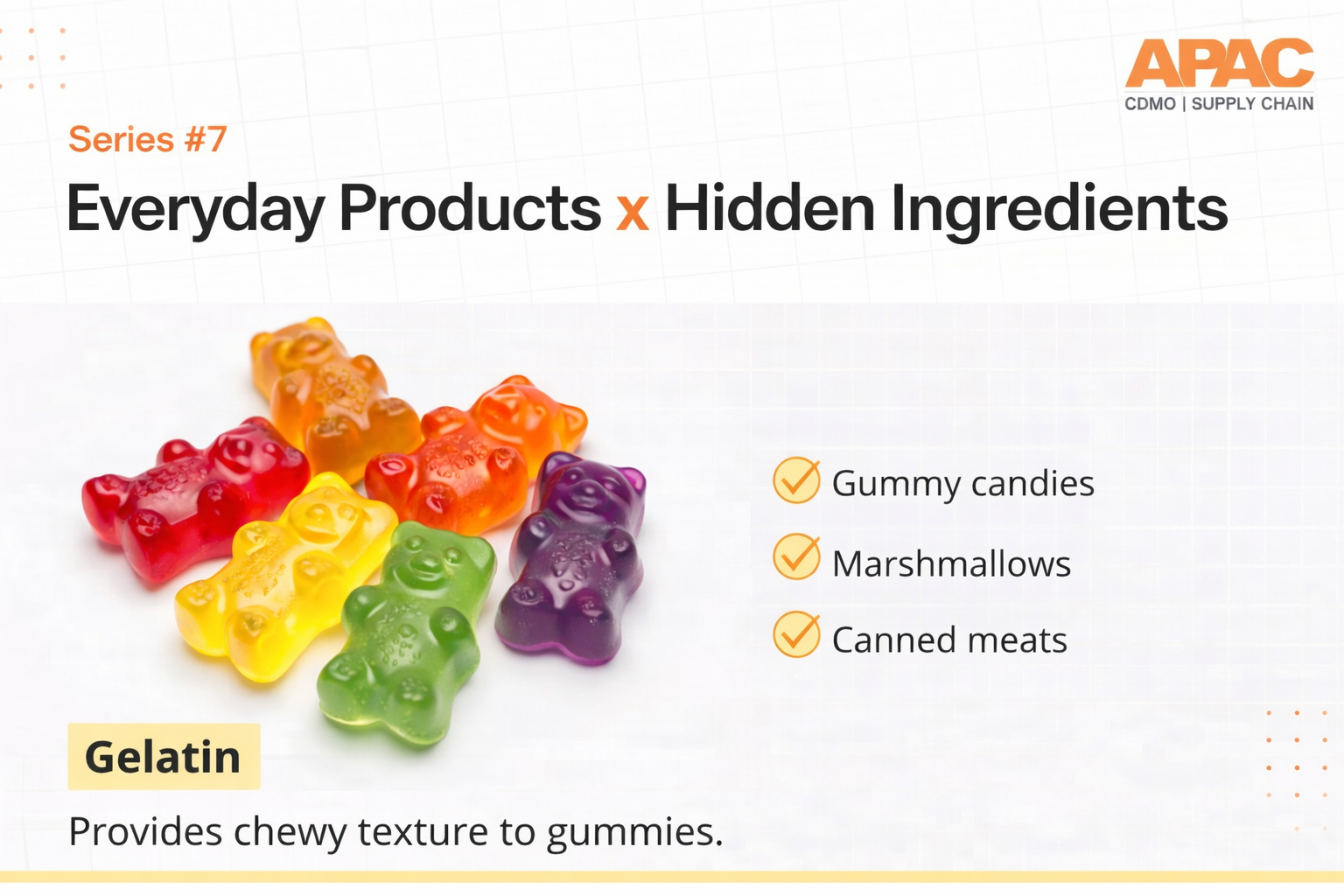
APAC Supply Chain | CDMO · Series: Everyday Products × Hidden Ingredients · April 2026
Reading time: ~10 minutes · Category: Ingredients & Raw Materials · SEO: Gelatin / Gelatin Supplier India
Gelatin: The Hidden Ingredient Behind Your Gummy Bears, Pharma Capsules, and Surgical Sponges — Complete Sourcing Guide
Meta Description: Gelatin is one of the most widely used protein-based ingredients in pharmaceutical capsule manufacturing, food texture systems, nutraceutical delivery, and medical devices. Discover its chemistry, commercial grades, applications, global supply chain dynamics, and why procurement teams across Asia trust APAC Supply Chain for bulk Gelatin sourcing.
Every time you bite into a gummy bear, swallow a soft gel vitamin capsule, eat a spoonful of panna cotta, or benefit from a surgical haemostatic sponge — there is a very high probability that gelatin is doing the quiet, essential work behind the scenes.
Gelatin is a colourless, flavourless, water-soluble protein derived from the controlled partial hydrolysis of collagen — the structural protein found in the bones, hides, and connective tissues of animals. It is one of the oldest functional ingredients in human history, and simultaneously one of the most technically sophisticated raw materials in modern pharmaceutical manufacturing, food formulation, and medical device production.
In this complete sourcing guide, we break down everything procurement managers, R&D formulators, and supply chain professionals need to know about Gelatin: its chemistry, commercial grades, key applications across industries, manufacturing process, global market dynamics, and how to source it reliably at scale with the right documentation.
Table of Contents
- What Is Gelatin?
- Chemical Properties & Commercial Grades
- How Gelatin Works: Key Functional Mechanisms
- Industrial & Commercial Applications
- How Gelatin Is Manufactured
- Global Market & Supply Chain Overview
- How to Source Gelatin: What Buyers Need to Know
- Why APAC Supply Chain & CDMO for Gelatin Procurement
- Frequently Asked Questions (FAQ)
- Conclusion
1. What Is Gelatin?
Gelatin is a naturally derived protein obtained by the partial hydrolysis of collagen — the most abundant structural protein in mammals, found in skin, bones, cartilage, tendons, and connective tissue. When collagen is subjected to controlled heat and moisture, the triple-helix protein structure partially unravels, yielding gelatin: a polydisperse mixture of peptide chains with unique gelling, film-forming, and adhesive properties that no purely synthetic ingredient has been able to fully replicate.
Commercially, gelatin is produced primarily from bovine hides and bones, and porcine skins — the two dominant raw material streams globally — with fish gelatin emerging as an important alternative for markets requiring halal, kosher, or non-bovine/non-porcine sourcing. It is sold as a dry powder or granules with varying bloom strength, viscosity, and pH, and is classified as a food additive, pharmaceutical excipient, nutraceutical ingredient, and medical device material depending on grade and application.
What makes gelatin commercially indispensable across so many industries is a combination of properties that cannot be easily replicated: it melts precisely at body temperature (giving gummies their characteristic melt-in-mouth experience), it forms strong, flexible, oxygen-impermeable films (making it ideal for capsule shells), it is fully digestible and biocompatible (enabling surgical and medical applications), and it behaves as both a gelling agent and a stabiliser across a wide range of formulation matrices.
Key fact: Gelatin is classified as GRAS (Generally Recognized As Safe) by the US FDA and is approved as a food additive under EU regulation (E441). It holds monograph status in USP, BP, EP, and IP — making it one of the most universally accepted protein-based excipients in global pharmaceutical manufacturing. The global hard capsule market alone — overwhelmingly gelatin-based — exceeded USD 1.5 billion in 2025 and continues to grow.
2. Chemical Properties & Commercial Grades
Basic Chemistry
- Chemical Nature: Heterogeneous mixture of water-soluble proteins and peptides derived from collagen hydrolysis
- Also Known As: Gelatine, edible gelatin, pharmaceutical gelatin, hydrolysed collagen (partial hydrolysis form)
- CAS Number: 9000-70-8
- Composition: Predominantly glycine (~33%), proline (~12%), and hydroxyproline (~11%) — an amino acid profile unique to collagen-derived proteins
- Molecular Weight: Polydisperse — typically 15,000–400,000 Da depending on source material and processing conditions
- Appearance: Light yellow to amber translucent granules or powder; colourless to pale yellow gel when hydrated
- Odour: Faint, characteristic; essentially odourless in refined pharmaceutical grades
- Solubility: Insoluble in cold water; swells and absorbs 5–10× its weight; dissolves fully in hot water (>40°C) to form a sol; gels upon cooling below ~30°C
- Bloom Strength: 50–300 g — the single most important quality parameter for formulators; measures gel stiffness
- Gel Melting Point: 27–34°C — this body-temperature melt behaviour is a defining functional characteristic
- Isoelectric Point: ~pH 7–9 (Type A, acid-processed); ~pH 4.7–5.3 (Type B, alkali-processed)
- Viscosity: 1.5–7.5 mPas (6.67% solution at 60°C) — affects capsule film quality and coating applications
Commercial Grades
- Pharmaceutical Grade (USP / BP / EP / IP): Highest purity with full pharmacopoeial compliance — mandatory for hard capsule shells (HGC), soft gelatin capsules (SGC), plasma expanders, and medical device applications. Requires batch CoA, heavy metal testing to ICH Q3D limits, microbial testing, TSE/BSE risk assessment documentation, and full traceability to raw material origin.
- Food Grade (FCC / E441): Compliant with Food Chemicals Codex and EU E441 designation. Meets specific heavy metal, sulphur dioxide, and microbial purity standards. Used in confectionery (gummies, marshmallows), dairy (yoghurt, panna cotta), processed meat, and beverage fining applications.
- Nutraceutical / Supplement Grade: High purity with Halal, Kosher, and/or Non-GMO certification depending on market requirements. Used for soft gel supplement capsules, collagen peptide powders, joint health products, and protein enrichment. Often requires additional testing for contaminants relevant to wellness applications.
- Cosmetic Grade: Controlled purity and low colour suitable for hair masks, nail hardeners, skin creams, and collagen-positioning personal care products. Must comply with ISO 16128 and regional cosmetic ingredient regulations.
- Medical / Technical Grade: Haemostatic sponges, surgical gelatine foam, microbiological culture media, and photographic emulsions. Requirements vary significantly by end application — consult regulatory team before specifying.
Procurement tip: Always specify bloom strength, viscosity grade, species of origin (bovine / porcine / fish), pre-treatment type (Type A acid-processed or Type B alkali-processed), and required certifications (Halal / Kosher / TSE-BSE free / pharmacopoeial standard) at the RFQ stage. Supplying an incorrect bloom strength is one of the most common and costly formulation errors in capsule manufacturing and confectionery production — a 50-bloom mismatch can render an entire production batch unusable.
3. How Gelatin Works: Key Functional Mechanisms
Gelatin's extraordinary versatility across food, pharmaceutical, and medical applications stems from several distinct physicochemical mechanisms that activate different functional properties depending on application context:
Thermoreversible Gelation
Gelatin solutions undergo a reversible sol-gel transition: liquid above ~35°C, forming a firm elastic gel upon cooling below ~30°C. This thermoreversible behaviour — unique among commercial gelling agents — is the basis of its use in confectionery (gummies, jellies), pharmaceutical capsule manufacture, and microencapsulation. The gelling temperature closely approximates body temperature, which is why gelatin-set products melt in the mouth while remaining firm at ambient conditions.
Film Formation & Barrier Properties
When cast and dried, gelatin forms flexible, transparent, oxygen-impermeable films with excellent tensile strength. This property is fundamental to hard and soft gelatin capsule manufacturing — the gelatin film encapsulates APIs, protecting them from oxygen, moisture, and light while providing a controlled disintegration profile. Film strength and flexibility are directly correlated to bloom strength, viscosity, and plasticiser content.
Water Binding & Texture Modification
Gelatin molecules carry charged amino acid residues that interact strongly with water molecules, enabling it to bind and immobilise large quantities of free water within a protein network. This water-binding capacity provides the characteristic chewiness, body, and mouthfeel of gummy confectionery, marshmallows, and stabilised dairy desserts — texture qualities that plant-based alternatives consistently struggle to replicate with equal sensory fidelity.
Colloidal Stabilisation & Emulsification
As an amphoteric polyelectrolyte, gelatin adsorbs at oil-water and air-water interfaces, stabilising emulsions, foams, and suspensions. It is used as a protective colloid in photographic emulsions, a foam stabiliser in desserts, and a stabilising matrix in microencapsulated ingredient delivery systems for functional food and nutraceutical applications.
Biocompatibility & Biodegradability (Medical Applications)
Gelatin is fully biocompatible, non-antigenic at standard pharmaceutical purity, and biodegradable by endogenous proteases. These properties make it uniquely suited for medical applications including absorbable haemostatic sponges, plasma volume expanders, and as a scaffold material in tissue engineering. Its degradation rate can be modulated by crosslinking, enabling controlled-release applications in advanced drug delivery systems.
4. Industrial & Commercial Applications of Gelatin
4.1 Pharmaceutical: Capsule Manufacturing (Largest Single Application)
Gelatin capsules — both hard gelatin capsules (HGC) and soft gelatin capsules (SGC / softgels) — represent the single largest volume application of pharmaceutical-grade gelatin globally, accounting for over 60% of total gelatin consumption in the pharmaceutical sector. Hard capsules are manufactured on high-speed dipping machines where stainless steel pins are dipped into precisely controlled gelatin solutions, dried, stripped, and cut to produce two-piece capsule bodies and caps. Softgels are produced by the rotary die process, encapsulating liquid or semi-solid fills in a continuous gelatin ribbon.
For capsule manufacturers, the critical quality parameters are bloom strength (typically 150–275 g for HGC; 150–200 g for SGC), viscosity (matching machine specifications), moisture content, and microbial compliance. Batch-to-batch consistency in these parameters is non-negotiable — even minor variation in bloom strength or viscosity causes capsule shell defects, production stoppages, and batch failures that are extremely costly at commercial scale.
4.2 Food & Confectionery
Gelatin is a cornerstone ingredient across multiple food categories:
- Gummy confectionery: Provides the characteristic elastic, chewy texture in gummy bears, worms, rings, and functional gummy vitamins. Typically 200–250 bloom bovine or porcine gelatin at 6–10% inclusion in the finished product.
- Marshmallows: Acts as the aeration stabiliser and texture agent, creating the characteristic foam structure and chewiness. Lower bloom grades (100–150 g) are standard for marshmallow production.
- Dairy desserts: Panna cotta, bavarian creams, mousse, and set yoghurts use gelatin for controlled texture and stability.
- Processed meats: Used in aspic, meat loaves, and restructured meat products as a binding agent and moisture retainer.
- Beverage fining: Wine and juice clarification using gelatin as a fining agent to precipitate tannins, phenolics, and particulate matter.
- Coatings & glazing: Applied as a protective glaze on baked goods, fruit, and confectionery to extend shelf life and improve appearance.
4.3 Nutraceuticals & Dietary Supplements
The global collagen supplement market — driven by consumer demand for skin, joint, and gut health benefits — has created enormous growth in hydrolysed gelatin (collagen peptide) consumption. Collagen peptides are produced by further enzymatic hydrolysis of gelatin to low molecular weight peptides (typically 1,000–5,000 Da) that are water-soluble, tasteless, and bioavailable — making them ideal for powder supplements, functional beverages, and protein enrichment applications. This segment is growing at over 8% CAGR and is one of the fastest-growing applications for bovine and marine collagen-derived gelatin globally.
4.4 Medical & Surgical
- Haemostatic sponges: Absorbable gelatin sponges used in surgical settings to control bleeding — the gelatin matrix provides a scaffold for platelet aggregation and clot formation.
- Plasma volume expanders: Modified fluid gelatin (MFG) and succinylated gelatin solutions are used as intravenous colloids for volume replacement in emergency medicine and surgery.
- Microbiological culture media: Nutrient gelatin agar is a classical microbiological medium for bacterial identification and liquefaction testing.
- Tissue engineering scaffolds: Crosslinked gelatin hydrogels are used as 3D cell culture matrices and tissue regeneration scaffolds in regenerative medicine research.
4.5 Cosmetics & Personal Care
Gelatin and hydrolysed gelatin (collagen) appear in nail hardeners, hair repair treatments, skin creams, and peel-off masks, leveraging both the protein's film-forming properties and its marketing association with collagen and skin health. Hydrolysed collagen peptides — a downstream gelatin derivative — are among the most widely marketed beauty supplement and cosmetic ingredient categories globally.
5. How Gelatin Is Manufactured
Gelatin manufacturing is a capital-intensive, multi-step process requiring strict GMP controls and raw material traceability. The process differs depending on whether acid (Type A) or alkaline (Type B) pre-treatment is used:
Step 1: Raw Material Sourcing & Inspection
Bovine hides, bovine bones, or porcine skins are sourced from certified slaughterhouses under veterinary oversight. For pharmaceutical-grade gelatin, raw materials must come from BSE/TSE risk category I or II countries (per EC Regulation 999/2001), with full animal identity traceability. Each incoming batch is inspected for freshness, contamination, and compliance with species verification requirements.
Step 2: Pre-treatment (Acid or Alkaline)
Type A (Acid-processed): Raw material (typically porcine skin) is treated with dilute hydrochloric or sulphuric acid (pH 1.5–3.0) for 10–24 hours. Acid pre-treatment produces gelatin with a higher isoelectric point (~pH 8–9), higher bloom strength, and better clarity — preferred for pharmaceutical capsule applications.
Type B (Alkali-processed): Raw material (typically bovine hides and bones) undergoes prolonged liming treatment (calcium hydroxide, pH 12–13) for 8–20 weeks. Alkaline pre-treatment produces gelatin with a lower isoelectric point (~pH 4.7–5.3) — widely used in food applications.
Step 3: Hot Water Extraction (Multi-stage)
Pre-treated raw material is subjected to a series of sequential hot water extractions at progressively higher temperatures (55°C → 65°C → 75°C → 95°C). Each extraction stage yields a gelatin fraction of decreasing molecular weight and bloom strength. Higher-temperature fractions have lower bloom strength and are typically used in food or industrial applications, while the first lower-temperature fractions yield the highest-bloom pharmaceutical-grade material.
Step 4: Purification & Filtration
Extracted gelatin liquor undergoes defatting, ion exchange treatment (to remove heavy metals and ionic impurities), activated carbon treatment (colour and odour removal), and progressive membrane filtration (including ultrafiltration for pharmaceutical grades). These purification steps are critical for achieving pharmacopoeial compliance with heavy metal limits, particularly for ICH Q3D-relevant elements in pharmaceutical applications.
Step 5: Evaporation, Sterilisation & Drying
Purified gelatin solution is concentrated under vacuum at low temperature to preserve molecular weight integrity, then pasteurised or UHT-treated for microbial safety before final drying on steel belts or by spray drying. The final dried product is milled, blended for bloom standardisation if required, and tested comprehensively before release.
Step 6: Quality Testing & Documentation
Each production batch undergoes a full quality control battery: bloom strength, viscosity, pH, moisture content, ash, sulphur dioxide, heavy metals (Fe, Pb, Cd, As, Hg), total aerobic microbial count, Salmonella, E. coli, species identity confirmation (PCR for cross-contamination detection), and — for pharmaceutical grades — full pharmacopoeial compliance testing per USP, BP, or EP monograph. TSE/BSE risk assessment certificates accompany every pharmaceutical-grade shipment.
6. Global Market & Supply Chain Overview
The global gelatin market was valued at approximately USD 4.1 billion in 2025 and is projected to grow at a CAGR of approximately 6.0–6.5% through 2032, driven by expansion in pharmaceutical capsule production, functional food and nutraceutical demand, and the rapidly growing collagen peptide supplement sector across Asia, the Middle East, and North America.
Major Producing Regions
- Europe (France, Germany, Belgium, Netherlands): Home to the world's leading pharmaceutical-grade gelatin producers. European producers dominate the high-value pharmaceutical and food application segments with the highest quality TSE/BSE documentation integrity.
- South America (Brazil, Argentina): Major bovine gelatin producers benefiting from large cattle populations and BSE-free country status. Growing significantly in pharmaceutical applications.
- Asia (China, India, Southeast Asia): China is a major producer of food-grade and lower-specification gelatin, with significant porcine gelatin capacity. India produces both bovine and porcine gelatin for domestic pharmaceutical and food markets. Capacity and quality in Asia is improving rapidly — several Indian producers now hold USP/BP/EP compliance.
Market Pricing Benchmarks (2025–2026)
- Food grade bovine gelatin (200 bloom, E441): USD 3,500–5,500/MT (European origin, CIF Asia) — USD 2,200–3,500/MT (South American / Indian origin)
- Pharmaceutical grade gelatin (USP/BP/EP, 200–250 bloom): USD 6,000–12,000/MT — significant premium for pharmacopoeial compliance, TSE/BSE documentation, and batch traceability
- Fish gelatin (food/nutraceutical grade): USD 7,000–14,000/MT — premium for halal/kosher positioning and marine origin
- Hydrolysed collagen peptides (nutraceutical grade): USD 8,000–18,000/MT depending on molecular weight distribution, source species, and certification level
- MOQ: Typically 25–50 kg for samples; 500 kg–1 MT for trial orders; 5–25 MT for standard commercial orders; 50 MT+ for annual contract pricing
Buyer alert: Gelatin pricing varies enormously based on species origin, bloom strength, and documentation level — a pharmaceutical-grade European bovine gelatin can be 3–4× the price of a food-grade Chinese porcine gelatin at nominally the same bloom strength. Always compare quotes on a like-for-like specification basis: same species, same bloom grade, same pharmacopoeial standard, same certification package. Substituting a lower-grade or different-species gelatin without reformulation validation is a quality risk that has caused numerous regulatory non-conformances and product recalls.
7. How to Source Gelatin: What Buyers Need to Know
Sourcing gelatin correctly requires more technical diligence than most commodity ingredients — because gelatin specification errors have direct, immediate consequences on product performance, regulatory compliance, and consumer safety. Here are the critical factors procurement teams must address:
Species of Origin Declaration
Bovine, porcine, and fish gelatin have different functional properties, different regulatory requirements, and profoundly different market acceptability profiles. Porcine gelatin is not acceptable in halal markets; bovine gelatin from non-certified sources is not acceptable in halal or kosher applications; fish gelatin carries a premium but is universally acceptable and growing rapidly in religious and vegan-adjacent positioning. Always specify species of origin — and verify it with PCR-based species identity testing from the supplier's QC records or an independent laboratory.
TSE/BSE Risk Assessment Documentation
For pharmaceutical-grade bovine gelatin, TSE/BSE risk assessment is a non-negotiable regulatory requirement. Suppliers must provide a Certificate of Suitability (CEP) from the EDQM or equivalent TSE/BSE master file documentation confirming raw material country of origin, animal species, body parts used, and full compliance with applicable TSE/BSE risk minimisation measures.
Bloom Strength Matching to Application
Bloom strength is the single most application-critical specification parameter. Hard gelatin capsules require 200–275 bloom; softgels 150–200 bloom; gummy confectionery 200–250 bloom; marshmallows 100–150 bloom; and wine fining applications 50–100 bloom. Using a gelatin with incorrect bloom strength will cause product quality failures without any apparent supplier non-compliance, because the product met its nominal specification. Match bloom strength to your process, not just the grade label.
Halal, Kosher & Religious Certification
For pharmaceutical products, nutraceuticals, and food targeting Muslim-majority or Jewish markets — or for products with global labelling requiring halal/kosher certification — buyers must verify that the gelatin holds current, issued certification from a recognised certifying body. Halal certification for bovine gelatin requires not only that the cattle are slaughtered according to Islamic law, but that the slaughter facility, transport chain, and gelatin manufacturing plant are all covered under the same certification scope. Do not accept general "suitable for halal" claims — require the actual current certificate with scope details.
Documentation Package for Pharmaceutical Applications
For pharmaceutical buyers, the minimum required documentation package per shipment should include: Batch Certificate of Analysis (CoA) with full pharmacopoeial testing results, Certificate of Origin (CoO), Safety Data Sheet (SDS), Technical Data Sheet (TDS), TSE/BSE Certificate or CEP reference, species identity confirmation, and — if applicable — Drug Master File (DMF) number for US FDA submissions or a CEP from EDQM for European market pharmaceutical products. If sourcing from Indian manufacturers for regulated market supply, additionally verify WHO-GMP or EU-GMP certification status.
8. Why APAC Supply Chain & CDMO for Gelatin Procurement
At APAC Supply Chain | CDMO, we understand that gelatin procurement is not a commodity transaction — it is a formulation-critical and regulatory-critical decision with direct implications for product performance, patient safety, and supply continuity across pharmaceutical, food, and nutraceutical manufacturing.
Our sourcing team works with qualified, audited gelatin manufacturers across India, Europe, and South America to provide pharmaceutical, food, nutraceutical, and cosmetic grade gelatin with the species-specific traceability, bloom strength consistency, and documentation integrity that modern GMP manufacturing demands. Here is what differentiates our approach:
- Species & Application-Specific Sourcing: We don't offer a one-size-fits-all gelatin product. We work with your formulation or manufacturing team to identify the exact specification — species (bovine / porcine / fish), pre-treatment type (A or B), bloom strength, viscosity, pharmacopoeial standard (USP/BP/EP), and certification requirements (Halal / Kosher / TSE-BSE free) — and source from the right supplier for your specific use case.
- Full Documentation Package: Every shipment includes batch CoA with full pharmacopoeial test results, CoO, SDS, TDS, species confirmation, TSE/BSE certificates, and application-specific compliance documentation. For pharmaceutical customers, we support DMF referencing and EDQM CEP sourcing from qualified manufacturers.
- Regulatory Coverage — Regulated & Emerging Markets: Whether you're supplying US FDA, EMA, or CDSCO-regulated pharmaceutical products, or formulating for Middle Eastern halal markets or Southeast Asian food consumers, we understand the regulatory documentation requirements at each market level and source the right grade of gelatin with the right certification accordingly.
- ISO 9001:2015 & EcoVadis Committed: Our quality management system and sustainability accountability are third-party validated, giving your quality and compliance teams confidence to on-board us without extended supplier qualification timelines.
- Bloom-Consistent Supply: Gelatin is notorious for batch-to-batch bloom strength variability — particularly from suppliers operating without rigorous standardisation controls. We pre-screen supplier batches and, where required, work with manufacturers offering bloom-standardised product to protect your formulation and production schedule consistency.
- Rapid Qualification Support: Need to qualify a new gelatin supplier urgently — due to a TSE/BSE documentation gap, a supply disruption, a new halal market launch, or a pharmaceutical grade upgrade? Our team can mobilise samples, documentation, and supplier audit coordination within days, not months.
9. Frequently Asked Questions (FAQ)
What is the difference between Type A and Type B gelatin?
Type A gelatin is produced by acid pre-treatment — most commonly from porcine skin — and is characterised by a higher isoelectric point (pH 7–9), higher bloom strength relative to viscosity, and better clarity in solution. It is preferred for pharmaceutical hard capsule applications. Type B gelatin is produced by prolonged alkaline (lime) pre-treatment — typically from bovine hides and bones — and has a lower isoelectric point (pH 4.7–5.3). It is more widely used in food applications. The pre-treatment type affects formulation compatibility, particularly in systems sensitive to pH or ionic charge interactions — always specify both Type and species when requesting gelatin for critical pharmaceutical applications.
Is gelatin halal and kosher?
Gelatin can be halal or kosher, but only when produced from appropriately sourced and certified raw materials. Porcine gelatin is not permissible for halal or kosher applications under any circumstances. Bovine gelatin is permissible if the cattle were slaughtered according to halal (zabiha) or kosher requirements and the entire production chain holds valid third-party certification. Fish gelatin is generally accepted as halal and — depending on species — may also be kosher. For pharmaceutical products, nutraceuticals, and food sold into Muslim-majority or Jewish markets, you must obtain the actual current certificate from your supplier and verify its scope covers the specific product and production site, not just a general company-level approval.
What pharmacopoeial standards cover gelatin?
Gelatin holds official monograph status in all major global pharmacopoeias: USP-NF (United States Pharmacopeia), BP (British Pharmacopoeia), EP (European Pharmacopoeia — monograph 0330), and IP (Indian Pharmacopoeia). Food-grade compliance is governed by FCC (Food Chemicals Codex) and EU Regulation EC No 1333/2008 (E441). Each monograph specifies bloom strength ranges, viscosity, pH, moisture, ash, sulphur dioxide, heavy metals, and microbial limits — and these differ between pharmacopoeias. Always confirm which specific pharmacopoeial standard is required for your target market and intended use before placing orders.
Can plant-based alternatives replace gelatin in capsule manufacturing?
Hydroxypropyl methylcellulose (HPMC) capsules — also called vegetarian or vegan capsules — are the primary commercial alternative to gelatin in pharmaceutical hard capsule applications and have achieved significant adoption in the nutraceutical and herbal supplement sectors. However, HPMC capsules carry a significant cost premium over gelatin capsules (typically 2–4× higher per unit), have different disintegration profiles that may require formulation optimisation, and are more sensitive to moisture and static during filling operations. For conventional pharmaceutical applications with existing regulatory approvals based on gelatin capsule systems, switching to HPMC requires a change control process and in some cases regulatory re-submission. Gelatin capsules remain dominant in global pharmaceutical manufacturing, particularly in regulated markets and high-volume generic drug production.
What is bloom strength and why does it matter for procurement?
Bloom strength (measured in grams, via a standard bloom gelometer test) quantifies the stiffness or gel strength of a 6.67% gelatin solution — specifically, the force in grams required to depress a standard probe 4 mm into the surface of a gelatin gel set at 10°C for 17 hours. It is the most critical functional specification for gelatin procurement because it directly determines the texture, firmness, and mechanical performance of the finished product. Commercial gelatin is sold across a bloom range of approximately 50–300 g, with different applications requiring specific ranges. Supplying a 150-bloom product where a 250-bloom product is required will produce capsule shells that are too soft or brittle — a product quality failure that is invisible at the incoming quality check stage but catastrophic at the point of use.
How do I get a sample or quotation for Gelatin from APAC Supply Chain?
You can request product specifications, batch CoA, and samples by emailing our team at info@apacss.com. We supply pharmaceutical (USP/BP/EP), food (FCC/E441), nutraceutical (Halal/Kosher), and cosmetic grade gelatin in bovine, porcine, and fish variants, sourced from qualified manufacturers across India, Europe, and South America. Please specify your required grade, species of origin, bloom strength range, pre-treatment type (if known), intended application, target market, and annual volume estimate when enquiring — this allows us to recommend the optimal supplier and provide a meaningful commercial proposal. Minimum order quantities, pricing, lead times, and full documentation packages are available on request.
10. Conclusion
Gelatin is one of those quietly indispensable ingredients that most people encounter multiple times every day — in the gummies their children eat, the capsules they swallow, the surgical sponge in the operating room, the wine they drink — without ever knowing it's there. Yet for pharmaceutical formulators, confectionery manufacturers, nutraceutical brand owners, and medical device producers, gelatin is a cornerstone raw material whose reliable supply, correct specification, and rigorous documentation are entirely non-negotiable.
The complexity of sourcing gelatin correctly — selecting the right species, bloom strength, and pre-treatment type; verifying pharmacopoeial compliance and TSE/BSE documentation; managing halal and kosher certification integrity; maintaining formulation-critical batch-to-batch consistency; and navigating the very wide price and quality differential between suppliers across Asia and Europe — is precisely the kind of challenge that demands a procurement partner with deep category expertise, not simply a commodity trader with a price list.
At APAC Supply Chain | CDMO, we combine deep supplier relationships across India, Europe, and South America with rigorous quality management (ISO 9001:2015) and sustainability accountability (EcoVadis Committed) to give buyers across India, Southeast Asia, and the Middle East a procurement partner they can rely on for critical excipient and ingredient categories like Gelatin.
If you are reviewing your Gelatin sourcing strategy — whether you're qualifying a new supplier, expanding to a halal-certified source, upgrading to a pharmaceutical-grade product for a regulated market launch, or resolving a TSE/BSE documentation gap — we'd welcome the conversation. Reach out at info@apacss.com or explore our full ingredient portfolio at www.apacss.com.


