


APAC Chemical Sourcing 2026: Tariffs, Supply Shifts & What Buyers Must Do Now | APAC Sourcing Solutions
APAC Sourcing Solutions · Series: Supply Chain Intelligence · April 2026
Reading time: ~12 minutes · Category: Chemical Sourcing & Trade Intelligence · SEO: APAC Chemical Sourcing / Chemical Supplier India / Supply Chain 2026
APAC Chemical Sourcing in 2026: Tariffs, Supply Chain Shifts, and What Every B2B Buyer Needs to Do Right Now
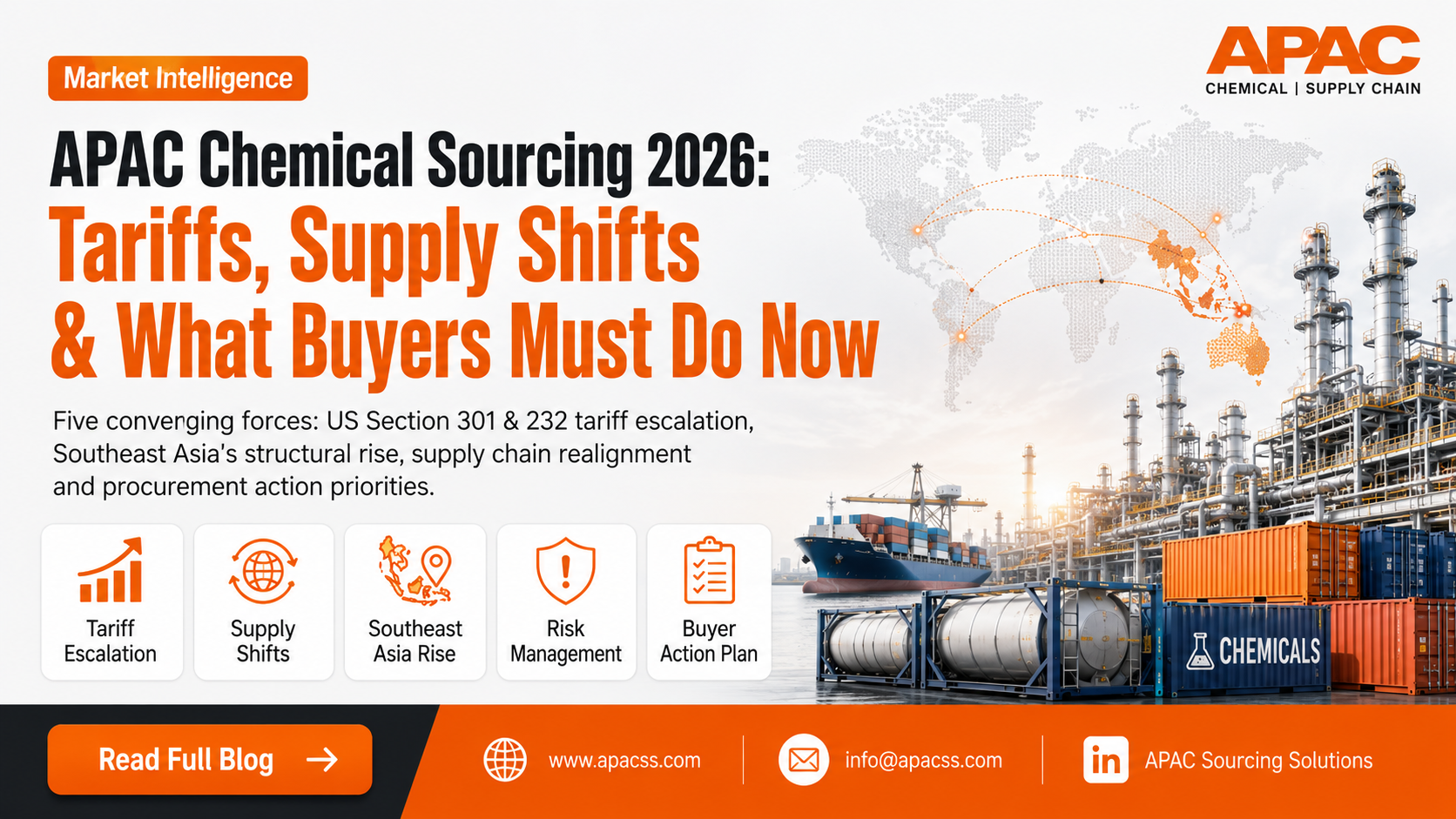
Summary: Five converging forces — US tariff escalation under Section 301 and 232, the accelerating shift of global supply chains into Southeast Asia, India's deepening role as a chemical manufacturing hub, the rise of AI-powered procurement tools, and tightening ESG compliance requirements — are fundamentally reshaping how B2B buyers source industrial chemicals, specialty chemicals, APIs, and raw materials across Asia-Pacific. This intelligence briefing breaks down each force, what it means for buyers in pharma, coatings, food & agriculture, and industrial sectors, and exactly what procurement teams should be doing now to protect supply continuity and cost competitiveness.
If you source chemicals from Asia — whether you are a pharmaceutical manufacturer buying APIs and excipients from India, a coatings producer sourcing resins and solvents from South Korea and China, a food manufacturer buying oleochemicals and surfactants from Southeast Asia, or an industrial buyer sourcing specialty chemicals across the APAC region — the ground has shifted under your feet in the first quarter of 2026. And the changes are accelerating, not stabilising.
New US tariff actions under Section 301 and Section 232 are now live, with direct implications for pharmaceutical ingredients, aluminum-derived raw materials, and chemical supply chains that pass through China, India, Vietnam, Indonesia, Thailand, and Malaysia. Southeast Asia is simultaneously absorbing a historic wave of supply chain diversification from China, creating both opportunity and new complexity for buyers. India is strengthening its position as the world's most strategically important source of pharmaceutical chemicals — while also facing new compliance scrutiny under US forced-labor investigations.
At APAC Sourcing Solutions, we operate Asia's B2B chemical bridge — connecting 3,000+ qualified Asian suppliers across India, China, South Korea, Taiwan, and Southeast Asia with 2,000+ global customers across pharmaceutical, industrial, food & agriculture, and coatings sectors. We have moved 65,000 MT+ of chemical volume, processed 3,500+ B2B shipping orders, and worked with 1,700+ manufacturers across the region. What we are seeing in our sourcing operations right now is a market in rapid, structural transition. This intelligence briefing shares what that means for your procurement strategy in 2026.
Table of Contents
- Force 1: US Tariff Escalation — Section 301 & 232 and the APAC Chemical Supply Chain
- Force 2: Southeast Asia's Rise as the New Global Sourcing Hub
- Force 3: India's Chemical Manufacturing Dominance — Opportunity and Compliance Complexity
- Force 4: AI-Powered Procurement — From Nice-to-Have to Operational Standard
- Force 5: ESG and Sustainable Procurement — Innovation Now Outpaces Compliance
- Your 2026 APAC Sourcing Action Plan: 5 Moves to Make Now
- How APAC Sourcing Solutions Navigates This For You
- Frequently Asked Questions (FAQ)
- Conclusion
1. Force 1: US Tariff Escalation — Section 301 & 232 and the APAC Chemical Supply Chain
The most immediately actionable development for APAC chemical buyers in April 2026 is the activation of new US trade policy measures with direct supply chain consequences — even for buyers who do not sell to the United States. Here is why: when US buyers diversify away from a tariffed supply source, they compete directly with you for the same alternative suppliers in India, Vietnam, South Korea, and Indonesia. Tariff actions reshape global supply and demand for the same chemicals you are buying, regardless of where your end product ships.
Section 232 Actions Effective April 6–7, 2026
New Section 232 measures now include a 100% tariff on certain patented pharmaceutical ingredients and a broadening of aluminum tariffs to the full customs value of aluminum articles and derivatives. For chemical buyers, the pharmaceutical ingredient tariff is directly material — it affects the import economics of APIs, drug intermediates, and specialty pharma chemicals moving from Asia into the US market, creating both price pressure and supply reallocation dynamics that will affect spot availability and contract pricing for key pharmaceutical raw material categories across Asia in 2026.
Section 301 Forced-Labor Investigations: Six APAC Economies Under Scrutiny
On March 12, 2026, the US Trade Representative (USTR) initiated a Section 301 investigation examining whether multiple economies prohibit imports of goods produced with forced labor. The investigation explicitly targets downstream products including chemicals, textiles, electronics, solar products, and auto parts — and covers six major APAC economies: China, India, Indonesia, Thailand, Vietnam, and Malaysia. This is not an abstract compliance exercise. It creates real documentation and due-diligence requirements for buyers sourcing from these countries, particularly for chemicals that pass through complex multi-tier supply chains where raw material origin traceability is difficult to verify.
Procurement alert: If you source specialty chemicals, APIs, petrochemical derivatives, or industrial raw materials from India, China, Vietnam, Indonesia, Thailand, or Malaysia — and any portion of your supply chain connects to the US market — you need to begin supply chain mapping now. Build a factual, data-supported record of origin, production steps, and supplier compliance. Companies that do not engage in this process now risk being caught without documentation when these investigations convert into tariff actions, which USTR's track record suggests will happen within 12–24 months of an investigation opening.
What This Means by Chemical Sector
- Pharmaceutical APIs & Excipients: Section 232 pharma tariff directly affects US-bound shipments. Indian manufacturers are accelerating EU-GMP and WHO-GMP upgrades to shift revenue mix away from US dependency — watch for short-term capacity tightening on key API categories.
- Organic & Petrochemicals (China origin): US inspection demand in China fell 18% in 2025. Chinese producers are redirecting supply to European, South American, and APAC-regional buyers — expect pricing pressure and availability improvements for non-US buyers sourcing organic chemicals from China in H1 2026.
- Oleochemicals & Surfactants (Southeast Asia): Indonesia and Malaysia remain the world's dominant palm-derivative supply chains. Section 301 forced-labor scrutiny is increasing documentation requirements for palm-based chemical derivatives — buyers must verify supply chain traceability for sustainable procurement compliance.
- Plastics, Solvents & Resins (South Korea): South Korea is not currently a Section 301 target and continues to supply global chemical markets without the compliance friction affecting China-origin product. South Korean suppliers of specialty solvents and engineering resins are seeing increased demand as Western buyers diversify away from Chinese sources.
2. Force 2: Southeast Asia's Rise as the New Global Chemical Sourcing Hub
Southeast Asia — and ASEAN as a trading bloc — is undergoing the fastest structural upgrade in its role in global chemical supply chains in a generation. What began as a China-plus-one manufacturing diversification trend in 2022–2023 has now matured into a full-scale strategic realignment, with procurement teams from North America, Europe, Latin America, and the Middle East actively building supplier relationships across Vietnam, Indonesia, Thailand, and Malaysia in parallel to their existing Chinese supply base.
The Numbers That Define the Shift
- Latin American and South American sourcing from Southeast Asia surged +61% year-on-year in 2025 — a structural shift, not a seasonal blip
- US and European B2B inspection demand in Southeast Asia grew at the regional average while new buyers from emerging markets accelerated — confirming Southeast Asia's capacity to absorb diversified demand
- The ASEAN Digital Economy Framework (DEFA), set for completion in 2026, is enabling smoother digital trade, e-invoicing, and cross-border documentation flows across the bloc — reducing operational friction for buyers managing multi-country sourcing networks
- Global electronics manufacturing exceeds $2.3 trillion in 2026, with Vietnam and Malaysia supplying critical chemical inputs — specialty solvents, electronic-grade acids, and surface treatment chemicals — for this production base
Key Chemical Categories Shifting to Southeast Asia
- Oleochemicals & Surfactants: Indonesia and Malaysia supply the world. Palm fatty acids, stearic acid, glycerine, and their derivatives continue to come primarily from this region, with sustainability certification (RSPO) becoming a baseline requirement for European and US buyers.
- Green & Sustainable Chemicals: Bioplastics, bio-based surfactants, and certified sustainable derivatives are growing at double-digit rates, with Indonesia, Vietnam, and Thailand leading Asia-Pacific supply. Buyers sourcing sustainable chemistry must now engage Southeast Asian producers directly — not just European suppliers at 2–3× the price.
- Electronic-Grade Specialty Chemicals: Vietnam and Malaysia's electronics manufacturing base creates sourcing clusters for high-purity acids, specialty gases, and surface treatment chemicals. Buyers in industrial cleaning, semiconductor packaging, and advanced electronics applications should map Vietnam and Malaysia into their approved vendor lists in 2026.
- Food & Agricultural Chemicals: Enzymes, feed additives, and crop protection chemical intermediates are a growing Southeast Asian specialty — particularly from Thailand (food enzymes) and Indonesia (agricultural chemistry). Q1 and Q3 seasonality in agricultural chemistry demand rewards buyers who lock in supply early.
APAC Sourcing Solutions covers Southeast Asia directly through our SEA & Middle East supplier network spanning oleochemicals and surfactants. If you are qualifying new Southeast Asian suppliers for an established chemical category, our vendor validation process — WHO-GMP compliance checks, ISO 9001 audits, and plant accreditation reviews — can accelerate your supplier qualification timeline significantly.
3. Force 3: India's Chemical Manufacturing Dominance — Opportunity and Compliance Complexity
India's position in the global chemical supply chain has never been stronger — or more complex to navigate from a compliance perspective. The country supplies industrial and specialty chemicals, pharmaceutical APIs and excipients, agrochemicals, dyes, pigments, and a rapidly growing portfolio of performance chemicals to buyers across 50+ countries. With 1,700+ manufacturers in our supplier network and deep roots in India's chemical manufacturing clusters — Gujarat, Maharashtra, Telangana, Himachal Pradesh, and Rajasthan — we are witnessing firsthand both the opportunity and the challenge of sourcing from India in 2026.
Why India Is the Strategic Chemical Source of 2026
- Pharmaceutical APIs and Excipients: India is the world's third-largest pharmaceutical producer by volume and the dominant source of generic API supply globally. With Section 232 pressure on China-origin pharma ingredients increasing, Indian API manufacturers are seeing accelerated demand from US and European buyers actively diversifying their pharmaceutical supply chains.
- Industrial & Specialty Chemicals: India's chemical industry has grown at 9–10% CAGR and now spans the full value chain — from basic intermediates to highly engineered specialty performance chemicals. Gujarat alone houses the highest concentration of chemical manufacturing capacity in Asia outside China.
- Cost Competitiveness vs. Quality Upgrade: Indian manufacturers have historically competed on price; the sector is now completing a quality upgrade cycle with WHO-GMP, ISO 9001, EU-GMP, and REACH certifications becoming standard among Tier 1 suppliers — enabling buyers to access Indian manufacturing cost economics without sacrificing documented quality compliance.
- India Chemical Distribution (APAC Sourcing Solutions Specialty): Our India Chemical Distribution service provides import, distribution, and India-market access for specialty and life sciences chemicals — giving global chemical manufacturers a compliant, well-documented route to one of Asia's fastest-growing chemical end-markets.
The Compliance Complexity Buyers Must Navigate
The Section 301 forced-labor investigation covering India — while distinct from the primary China-focused narrative — creates real documentation obligations for buyers. India's chemical supply chains involve complex multi-tier structures, particularly for natural-derived chemicals (castor oil derivatives, oleochemicals, natural resins, essential oils) where raw material origin traceability through the agricultural supply chain is genuinely difficult to document. Buyers sourcing natural-derived Indian chemicals for regulated markets in Europe and North America need to begin supply chain mapping at the raw material level — not just at the manufacturer's factory gate.
Vendor validation is our core differentiator: Every supplier in the APAC Sourcing Solutions network undergoes WHO-GMP and ISO 9001 validation, plant audits, and accreditation review before commercial supply begins. In the current regulatory environment, a supplier without documented validation is not a supplier — it is a liability. Our 3,000+ validated suppliers represent a pre-qualified supply base that dramatically reduces the compliance overhead for buyers entering or expanding their Indian sourcing footprint.
4. Force 4: AI-Powered Procurement — From Nice-to-Have to Operational Standard
The procurement technology conversation in APAC has moved decisively in the last 18 months — from "should we explore AI tools?" to "our competitors are already using them and we are behind." For B2B chemical buyers in 2026, AI is not a technology investment discussion; it is a supply chain risk management discussion. The organisations that are using AI in procurement are identifying disruptions earlier, qualifying alternative suppliers faster, and managing documentation compliance with less manual overhead than those that are not.
Where AI Is Already Delivering Value in Chemical Procurement
01 — Predictive Risk Intelligence
AI-powered risk platforms now integrate real-time data from shipping route disruptions, port congestion, geopolitical signals, weather events, and regulatory announcement feeds to provide procurement teams with early-warning indicators before supply disruptions materialise. For chemical buyers managing multi-country sourcing networks across APAC — where a monsoon in India, a port strike in South Korea, or a regulatory action in Vietnam can affect supply continuity within days — predictive risk intelligence is shifting from a competitive advantage to a baseline operational requirement.
02 — AI-Accelerated Supplier Qualification
Traditional supplier qualification in the chemical sector — particularly for pharmaceutical-grade materials — involves weeks of document collection, review, and verification. AI tools are now able to cross-reference supplier documentation against pharmacopoeial databases, regulatory non-compliance registries, and quality incident records in minutes, compressing qualification timelines from months to days for buyers who need to respond quickly to supply disruptions or new market opportunities. In a tariff-driven supply realignment environment — where buyers are actively qualifying new Indian or Southeast Asian suppliers to replace disrupted Chinese sources — this speed advantage is commercially material.
03 — Autonomous Procurement Workflows
Leading procurement technology providers are implementing AI-driven autonomous approval systems for routine procurement decisions — repeat orders within approved supplier lists, standard documentation review, and compliance checklist verification. For chemical buyers managing high-frequency, lower-complexity transactions (commodity industrial chemicals, standard excipients, packaging raw materials), autonomous workflows can free procurement professionals to focus on strategic sourcing decisions, supplier relationship development, and the complex, high-value negotiations where human expertise and relationship context still decisively matter.
Key insight from the 2026 Sustainable Procurement Barometer (EcoVadis & Accenture, April 2026): Among the top 10% of procurement performers, 80% now cite innovation — not compliance — as the primary driver of ROI in their procurement programs. 58% of leading organisations run innovation initiatives across 26–75% of their supplier spend. The era of procurement-as-cost-management is giving way to procurement-as-competitive-advantage — and the chemical sector is not exempt from this shift.
5. Force 5: ESG and Sustainable Procurement — Innovation Now Outpaces Compliance
Environmental, Social, and Governance requirements in chemical procurement have undergone a fundamental reorientation in 2025–2026. For the first three years of the ESG procurement cycle, most chemical buyers — particularly in Asia — treated sustainability as a compliance exercise: complete the supplier questionnaire, collect the certifications, file them in the audit folder, move on. That model is finished for buyers supplying regulated markets, global brands, or customers with science-based targets. ESG in chemical procurement is now a sourcing strategy — and the buyers who treat it that way are unlocking cost savings, supply security advantages, and market access that compliance-focused buyers are not.
The Three Core ESG Priorities in APAC Chemical Sourcing (2026)
Net-Zero and Carbon Management
Managing supply chain emissions and advancing net-zero progress is cited as a top-three program focus area by 54% of organisations globally, according to the 2026 EcoVadis/Accenture Barometer. For chemical buyers, this translates into direct action: requiring Scope 3 emissions reporting from suppliers, preferring bio-based or lower-carbon chemistry where it is technically equivalent, and building carbon accounting into total cost of ownership calculations for chemical category decisions. Chemical manufacturing is one of the most carbon-intensive industry sectors — which means that procurement decisions in this category have outsized impact on a buyer's supply chain carbon footprint.
Supplier Workforce Practices
The Section 301 forced-labor investigation is not occurring in isolation — it reflects a global regulatory direction that is requiring B2B buyers to demonstrate active due diligence on labor conditions across their supply chains. For chemical buyers sourcing from complex, multi-tier Asian supply chains, this means moving beyond supplier self-declaration to independent third-party audit evidence. The cost of not doing this is now regulatory and reputational risk — not just an ethical positioning question.
Circularity and Resource Efficiency
The global green packaging market reached $295 billion in 2025 and is forecast to grow at 6.5% CAGR through 2027. Sustainable electronics chemicals are growing at 23% annually. Bio-based surfactants, recycled-content solvents, and circular chemistry inputs are moving from niche to mainstream across multiple end-use markets. For B2B chemical buyers, this creates a sourcing requirement — not just a marketing opportunity — to identify and qualify suppliers who can provide certified sustainable alternatives at commercially viable scale.
APAC Sourcing Solutions is EcoVadis Committed and ISO 9001:2015 certified — providing third-party validated ESG credentials that give our customers' quality and compliance teams confidence to on-board us without extended supplier qualification timelines. For buyers subject to ESG supply chain reporting requirements, working through a validated intermediary like APAC Sourcing Solutions provides a documented, auditable procurement pathway for APAC chemical categories.
6. Your 2026 APAC Sourcing Action Plan: 5 Moves to Make Now
Given the five forces described above, here are the five concrete actions that procurement teams sourcing chemicals from Asia-Pacific should be executing in Q2 2026:
Move 1: Map Your Supply Chain Exposure to Section 301 and 232
Start with a category-level audit: identify which of your chemical categories originate from the six Section 301-covered APAC economies (China, India, Vietnam, Indonesia, Thailand, Malaysia) and whether any portion of your customer base has US market exposure. For each at-risk category, begin assembling the origin documentation, production step records, and supplier compliance evidence that would support a fact-based input to the USTR public comment process. Companies with prepared documentation records are significantly better positioned when tariff actions convert from investigation to implementation.
Move 2: Diversify Into Vietnam, Thailand, and Indonesia for Key Categories
If your chemical sourcing strategy currently has more than 60% concentration in China for any individual category, begin actively qualifying Southeast Asian alternatives. This is not about abandoning Chinese supply — it is about building the approved vendor infrastructure so that when you need to shift supply (due to tariff escalation, quality issues, or logistics disruption), the alternative is ready to activate. Southeast Asian supplier qualification timelines are typically 3–6 months; start now, before the pressure event forces a rushed decision.
Move 3: Embed AI Risk Tools Into Your Sourcing Workflows
Identify at least one AI-powered supplier risk or procurement intelligence tool to pilot in Q2–Q3 2026. The minimum viable implementation for a chemical buyer is a real-time supply disruption monitoring feed covering your key sourcing geographies and a supplier risk scoring layer over your existing approved vendor list. Most platforms now offer API integration with existing ERP and procurement systems — the barrier to implementation is lower than most procurement teams assume.
Move 4: Align Supplier KPIs With Net-Zero and ESG Targets
For your top 20–30 suppliers by spend value, add three sustainability KPIs to your next annual supplier review: Scope 1 and 2 emissions intensity (kg CO2 per MT of product), third-party labor compliance audit status, and water consumption intensity. You do not need a perfect ESG measurement framework on day one — you need to begin the data collection process so that in 12–18 months, when your customers or regulators ask for supply chain ESG data, you have a baseline to report from.
Move 5: Leverage the ASEAN DEFA for Digital Trade Simplification
With the ASEAN Digital Economy Framework completing in 2026, electronic invoicing, digital certificates of origin, and standardised customs documentation flows across ASEAN member states are becoming operational. For buyers managing multi-country Southeast Asian sourcing networks, this means a significant reduction in administrative friction — particularly for LCL (less-than-container-load) shipments that historically required complex manual documentation handling at each ASEAN border crossing. Work with your freight and customs partners now to understand which DEFA-enabled digital trade processes are live in your sourcing countries.
7. How APAC Sourcing Solutions Navigates This For You
APAC Sourcing Solutions operates as Asia's B2B chemical bridge — combining 15 years of regional supplier relationships, a validated network of 3,000+ suppliers across India, China, South Korea, Taiwan, and Southeast Asia, and four specialised service lines to give global chemical buyers a single, qualified point of access to APAC supply.
Here is how our four core service lines map directly to the 2026 market challenges described in this briefing:
- Strategic Sourcing (Supplier Discovery & Market Access): We identify and qualify the right supplier for your specific chemical requirement — specification, grade, volume, certification, and market compliance — across our 3,000+ supplier network. In the current environment of active supply chain diversification, we are executing new Southeast Asian and Indian supplier qualification projects for buyers who need to reduce China concentration risk in specific chemical categories. Our vendor validation process (WHO-GMP, ISO 9001, plant audit, accreditation review) provides documented due diligence that meets the compliance requirements of regulated-market buyers.
- Global Trading (Factory-to-Door, LCL / FCL Logistics): We handle factory-to-door delivery for chemical shipments across APAC, managing LCL and FCL logistics, customs documentation, and import compliance for 50+ destination countries. In a tariff-volatile environment where documentation integrity at customs is more scrutinised than at any point in the last decade, our logistics infrastructure and documentation standards are a practical risk mitigation mechanism — not just an operational convenience.
- CRAMs (Contract Manufacturing & R&D Grade Manufacturing): For buyers who need custom synthesis, process chemistry, or R&D-scale chemical manufacturing sourced from Asia — including pharmaceutical intermediates, specialty reagents, and formulation-specific chemical derivatives — our CRAM network in India and South Korea provides access to GMP-qualified contract manufacturing capacity with full IP protection, regulatory documentation, and batch-to-batch consistency management.
- India Chemical Distribution (Import & Distribution, Specialty & Life Sciences): For international chemical manufacturers seeking India market access, we provide a compliant, documented distribution and import management service that navigates India's evolving chemical import regulations, GST compliance requirements, and state-specific distribution logistics. India's chemical end-market is growing at 9–10% CAGR — and is one of the most complex markets in the world to enter without an established local partner.
Whether you are reviewing supplier diversification strategy, qualifying new Southeast Asian chemical sources, managing pharmaceutical API documentation gaps, navigating a tariff compliance question, or exploring India market distribution for a specialty chemical product — we welcome the conversation. Reach out at info@apacss.com or explore our full chemical portfolio and sourcing services at www.apacss.com.
8. Frequently Asked Questions (FAQ)
How are Section 301 and 232 tariffs affecting APAC chemical sourcing in 2026?
Section 232 actions effective April 6–7, 2026 introduced a 100% tariff on certain patented pharmaceutical ingredients and ingredients, and extended aluminum tariffs to the full customs value of aluminum articles. Section 301 investigations are examining forced-labor compliance across India, China, Vietnam, Indonesia, Thailand, and Malaysia — with downstream impact on chemicals, textiles, electronics, and auto parts supply chains. Even buyers who do not sell to the US are affected because these actions reshape global supply and demand for the same chemicals sourced across APAC, affecting spot availability and contract pricing for multiple chemical categories in 2026.
Which countries are best for chemical sourcing in Asia-Pacific in 2026?
India is the strongest source for pharmaceutical APIs, specialty chemicals, agrochemicals, dyes, and performance chemistry — with 1,700+ GMP-validated manufacturers and world-leading cost-quality positioning. China remains dominant in organic and petrochemicals despite US tariff pressure, and redirected supply is available to non-US buyers at competitive pricing. South Korea supplies plastics, solvents, and engineering resins without current Section 301 compliance friction. Taiwan leads in coatings and rubber chemicals. Vietnam, Indonesia, and Malaysia are the fastest-growing sources for oleochemicals, surfactants, green chemistry, and electronic-grade specialty chemicals — with ASEAN DEFA digital trade integration reducing operational sourcing complexity from 2026 onwards.
What documentation should a B2B buyer require when sourcing chemicals from Asia?
Minimum documentation for commercial B2B chemical shipments from Asia should include: Certificate of Analysis (CoA) with full analytical results, Certificate of Origin (CoO), Safety Data Sheet (SDS), Technical Data Sheet (TDS), relevant compliance certificates (ISO 9001, WHO-GMP, REACH where applicable), and Halal/Kosher certification where required. For pharmaceutical-grade materials, additionally require: pharmacopoeial compliance test results (USP/BP/EP/IP as applicable), Drug Master File (DMF) number or EDQM Certificate of Suitability (CEP) reference, TSE/BSE certificate for animal-derived materials, and full raw material traceability documentation. In the current Section 301 environment, retaining supply chain mapping documentation — showing origin, production steps, and labor compliance evidence — is increasingly important for buyers with US market exposure.
How is AI being used in chemical procurement and supplier risk management in APAC?
AI tools are now deployed in APAC chemical procurement for: real-time supplier risk assessment integrating shipping, geopolitical, and regulatory data feeds; predictive pricing analytics for key chemical commodity categories; automated supplier documentation review and compliance cross-referencing against pharmacopoeial and regulatory databases; supplier onboarding workflow automation reducing qualification timelines from months to days; and scenario planning for tariff and logistics disruption response. The 2026 Sustainable Procurement Barometer shows 80% of top procurement performers now prioritise innovation over compliance as their primary ROI driver — AI is the primary technology vehicle for that shift across the chemical sector.
How do I reduce China concentration risk in my chemical supply chain without disrupting supply continuity?
The most effective approach is parallel qualification: maintain your existing Chinese supply relationships while actively qualifying approved alternative sources in India, South Korea, or Southeast Asia for your highest-concentration or highest-risk chemical categories. Begin the qualification process 6–12 months before you expect to need it — validated alternatives take 3–6 months to qualify and onboard, and this timeline cannot be compressed when supply disruption pressure forces an emergency switch. Work with a sourcing partner who has pre-validated supplier networks across multiple APAC geographies, so that the alternative vendor evaluation process starts with a curated, pre-screened shortlist rather than a cold search across an unfamiliar supplier market.
How do I engage APAC Sourcing Solutions for a new chemical sourcing requirement?
Contact our sourcing team at info@apacss.com with your chemical specification, required grade, intended application, target market, annual volume estimate, and any specific certification or documentation requirements. We cover industrial and specialty chemicals, pharmaceutical APIs and excipients, food and agricultural chemicals, coatings and rubber chemistry, oleochemicals and surfactants, and CRAMs contract manufacturing. Please specify whether you are looking for strategic sourcing, global trading logistics, contract manufacturing (CRAMs), or India market distribution — this helps us direct your enquiry to the right team immediately.
9. Conclusion
The APAC chemical sourcing landscape in 2026 is defined by five converging forces — US tariff escalation, Southeast Asia's structural rise as a sourcing hub, India's growing pharmaceutical and specialty chemical dominance, the mainstream adoption of AI-powered procurement, and ESG's evolution from compliance exercise to strategic differentiator. None of these forces is temporary. Together, they represent a fundamental structural shift in how chemical supply chains across Asia-Pacific are organised, how supplier relationships are qualified and managed, and how procurement teams must be structured and equipped to deliver competitive advantage rather than just cost compliance.
The buyers who navigate this shift successfully will be those who act now — not those who wait for the full impact to arrive before responding. Supply chain diversification takes months to execute. Supplier qualification cannot be rushed safely in regulated chemical categories. Documentation infrastructure for Section 301 compliance takes time to build. AI tool implementation requires organisational change. The 2026 window for proactive positioning closes faster than most procurement calendars anticipate.
At APAC Sourcing Solutions, we have 15 years of experience, 3,000+ validated suppliers, and a proven track record of 65,000 MT+ chemical volume delivered across 50 global partner markets. We are Asia's B2B chemical bridge — and in 2026, that bridge has never been more strategically valuable to the buyers who use it.
If you are reviewing your APAC chemical sourcing strategy for 2026 — whether you need to diversify suppliers, qualify new Southeast Asian or Indian sources, address a Section 301 documentation gap, upgrade to a GMP-compliant pharmaceutical chemical supply chain, or enter the India chemical market — we welcome the conversation. Contact us at info@apacss.com or visit www.apacss.com.


